
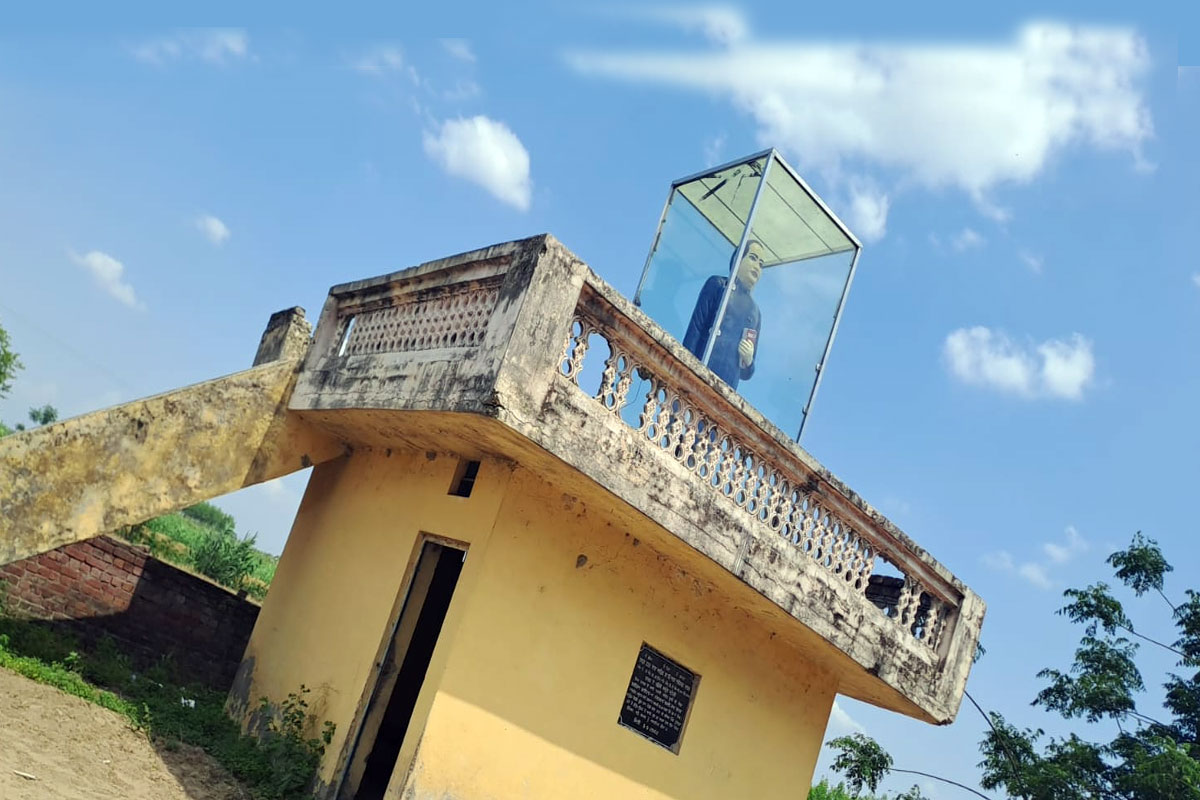
For many in village Noorpur Jattan (Hoshiarpur), the silence of the village outskirts has begun to feel unsettling. It was there, away from the cluster of homes and everyday movement, that the statue of Dr. B.R. Ambedkar was attacked again last week, following a similar incident in June last year—the statue’s face was defaced, glass panels shattered and lights broken. By March 30 morning, word had spread quickly. But the shock this time carried something heavier than anger: a sense of familiarity. This was not the first incident. Nor the second. In less than a year, this small village in Hoshiarpur district has witnessed three separate incidents, each targeting symbols that people here hold deeply personal—whether of faith or social identity. The local sentiment is that it is not just defacement; it feels like someone is trying to disturb the peace again and again.
The Ambedkar statue stands in isolation, a short distance outside the village. During the day, it is occasionally visited and at night, the area is largely deserted. After the first attack in June last year, protective glass and lighting were installed. But even those safeguards now lie broken—evidence that the site remains exposed. Locals say the problem is as much about location as it is about intent. Anyone can go there at night. There’s no one around, no cameras watching directly. After what happened earlier, everyone had thought there would be better security.
Notably, the earlier incident in June 2025 had already caused unease. The statue was vandalised and pro-Khalistan slogans were found scrawled at the spot. Two months before that, in April 2025, pages of the Guru Granth Sahib were found torn inside the village gurdwara. The discovery came after a religious gathering had ended—a time when the space should have been safe and respected. CCTV cameras were present but they were not working. This time, a video attributed to Gurpatwant Singh Pannu, leader of the banned outfit Sikhs for Justice (SFJ), claimed responsibility, bringing a wider, more troubling dimension to what might otherwise have been dismissed as local mischief.
Taken together, these incidents point toward a troubling trend, as repeated targeting of symbolic sites is tied to both religious and social identity within the same geographical pocket. The convergence of such incidents raises questions about whether these acts are isolated or part of a deliberate strategy to destabilise communal harmony.
For many in Noorpur Jattan, these incidents are no longer being seen in isolation. When it happens once, it’s shocking. When it happens again, it becomes worrying. But when it keeps happening, you start asking: why here? This question is now being asked quietly in homes and more openly in conversations at the village’s Satth (traditional gathering place of villagers).
According to the police, the answer to these questions may not lie entirely within the village. Men in khaki feel that social media is increasingly becoming a tool to influence and provoke. Some people get drawn in by what they see online. There are messages, videos and even promises of money for carrying out certain acts in the name of Khalistan. “Such allurements can be particularly effective among individuals who may not fully grasp the consequences. It’s not always about ideology. Sometimes it’s about vulnerability. What worries more is the possible intent behind the choice of targets. These incidents are not random. They touch both religious and social sentiments. There are indications that attempts are being made to not only create communal tension but also bring in a caste angle,” a senior police officer told The News Gateway, while preferring anonymity.
In a village where communities have largely coexisted without major fault lines, that possibility is unsettling. Back at the vandalised site, fragments of broken glass catch the light. For residents, they are a reminder of both the incident and what remains unresolved. Police have increased patrolling in the area and are examining footage from nearby locations. Officials continue to urge people to remain calm and not fall for rumours circulating online. But among villagers, there is a growing feeling that the response alone may not be enough.
Village sarpanch Shingara Ram, while speaking to The News Gateway, said, “There is a need to take steps to ensure the prevention of such incidents. If something is attacked again and again, it means something has been overlooked. Repeated incidents at the same location often point to a mix of intent and opportunity. In this case, the opportunity is clear: a secluded site, limited surveillance and gaps in follow-up after earlier incidents.”
Meanwhile, as evening falls in Noorpur Jattan, the road leading to the statue grows quiet again. For now, police presence may deter another immediate attempt. But the larger questions—about motive, influence and vulnerability—still linger and until those are answered, the fear in the village is not just about what has happened but about what might happen next.
(The author is a budding journalist. Views expressed are personal.)