



Ludhiana, March 7
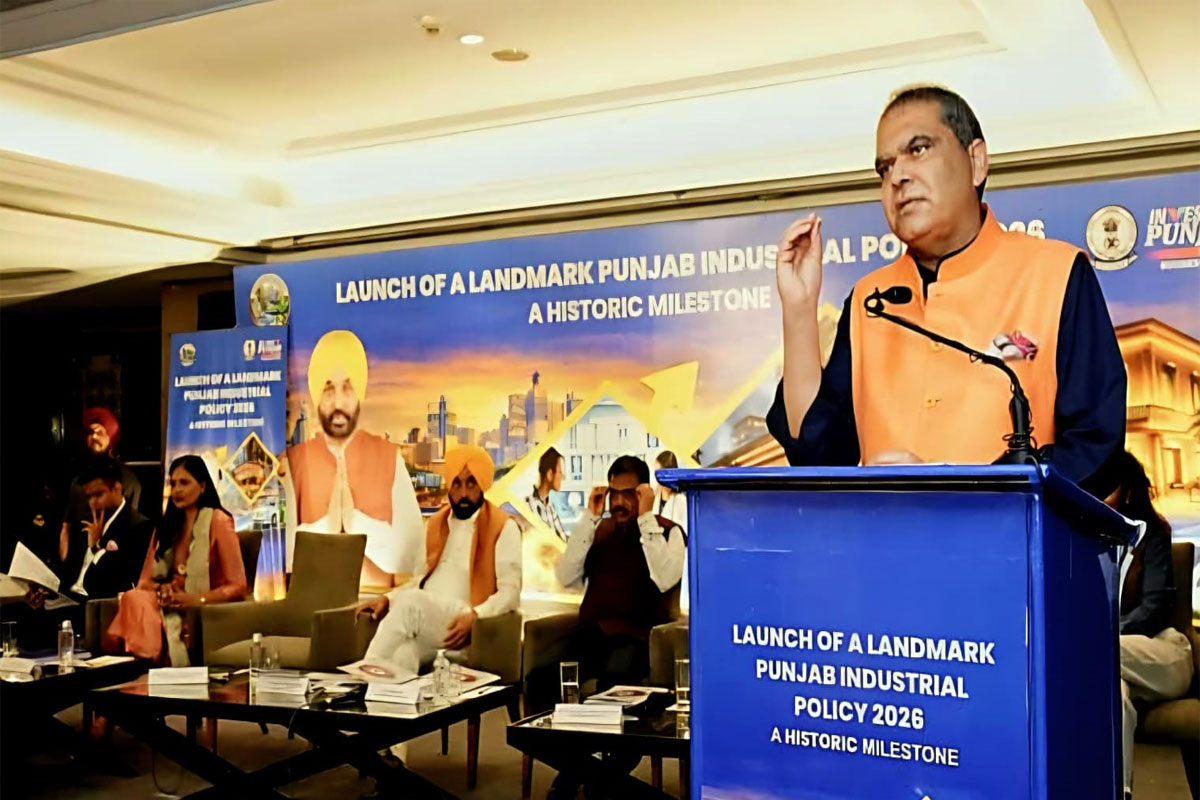
Punjab Chief Minister Bhagwant Mann on Saturday unveiled the landmark Industrial and Business Development Policy 2026 in Ludhiana, asserting that his government is determined to make Punjab the Number 1 investment destination in the country through bold reforms and a flexible incentive framework designed around the needs of industry. The Chief Minister asserted the Punjab Government has fundamentally restructured its industrial policy to accelerate industrial growth, attract large-scale investment and generate employment across Punjab.
Highlighting that Punjab is already witnessing record investment, the Chief Minister said the new policy allows investors to choose up to 20 incentives and design customised packages suited to their business models, introduces capital subsidy for the first time in Punjab, offers incentives of up to 100 per cent of Fixed Capital Investment and reduces Employment Generation Subsidy eligibility to ₹25 crore investment and 50 workers, thereby opening industrial incentives to a much wider base of businesses while strengthening Punjab’s position as a leading destination for manufacturing, services and emerging technology sectors.
Addressing the gathering, Mann said that the policy represents a major shift in the way industrial incentives are structured in Punjab. “Every other state in India hands investors a fixed menu and says take it or leave it, but Punjab has changed that. Now an investor can pick up to 20 incentives and build a package around their own business model.”
Explaining the rationale behind this approach, the Chief Minister said that different industries have different operational realities and cost structures. “Pharmaceutical companies need different support than an EV manufacturer, a data centre has different costs than a textile plant. The new policy acknowledges that and builds around it.” He said the framework allows investors to optimise incentives according to their sector, cost structure and scale of operations. “The incentive package can be optimised for their specific cost structure, their specific sector and their specific scale. That is money on the table that wasn’t there before.”
Highlighting another major feature of the policy, the Chief Minister stated that for the first time in Punjab’s history the government has introduced a capital subsidy. “If someone is planning a ₹100 crore plant, without capital subsidy ₹100 crore is their risk. With capital subsidy, the government co-invests a portion upfront and their capital at risk drops.” He added this significantly improves investment economics. “This means the same revenue with lower investment. Punjab is the first state in the country to offer that.”
The Chief Minister further observed that most industrial policies in other states are largely designed to attract new investors while existing businesses often receive little attention. “Most industrial policies in other states are drafted for outsiders with new investors, greenfield projects and companies being wooed from other states. Businesses already operating, already paying taxes and already employing people are usually an afterthought.” He said the new policy corrects this imbalance by extending incentives to modernisation and expansion projects as well. “Punjab’s new policy changes that as modernisation and expansion projects are now eligible for incentives. A Ludhiana manufacturer who wants to upgrade machinery, add a production line or expand capacity now gets policy support alongside new investors.”
The Chief Minister also highlighted that the policy provides long-term stability to investors through an extended incentive period. “Incentive support has been extended up to 15 years whereas most state policies run five to 10 years.” He said this provision is particularly important for capital-intensive sectors. “This is a big boon for heavy industry, semiconductors, pharmaceuticals, data centres and others as these are not businesses that return profit in year two but they are decade-long commitments.”
Explaining the financial significance of this provision, he stated, “Fifteen years changes the Net Present Value along with the total present value of all future incentives dramatically. For capital-intensive sectors this could be the single most important number in the entire policy.” The Chief Minister further asserted that the definition of Fixed Capital Investment has been expanded, which will increase the base on which incentives are calculated. “Fixed Capital Investment has been redefined as the base on which all incentives are calculated and it now includes land, labour housing, R&D facilities, effluent treatment plants, sewage treatment plants and zero liquid discharge systems.”
The Chief Minister noted the policy also focuses on making industrial incentives more accessible to smaller businesses. “Employment Generation Subsidy eligibility has been reduced to ₹25 crore investment and 50 workers.” He explained that earlier thresholds excluded many small and medium enterprises. “Previously the threshold was higher keeping many small and medium businesses outside the subsidy framework.” Emphasising the importance of smaller industries to Punjab’s economy, he said, “Punjab’s industrial backbone is not only large plants. It is the thousands of small manufacturers in Ludhiana, Jalandhar, Batala and Gobindgarh who employ 30, 40 or 50 people on thin margins.” “By bringing them inside the EGS framework, we are putting real money into the businesses that employ the most workers per rupee of investment,” he added.