



Ludhiana, February 20
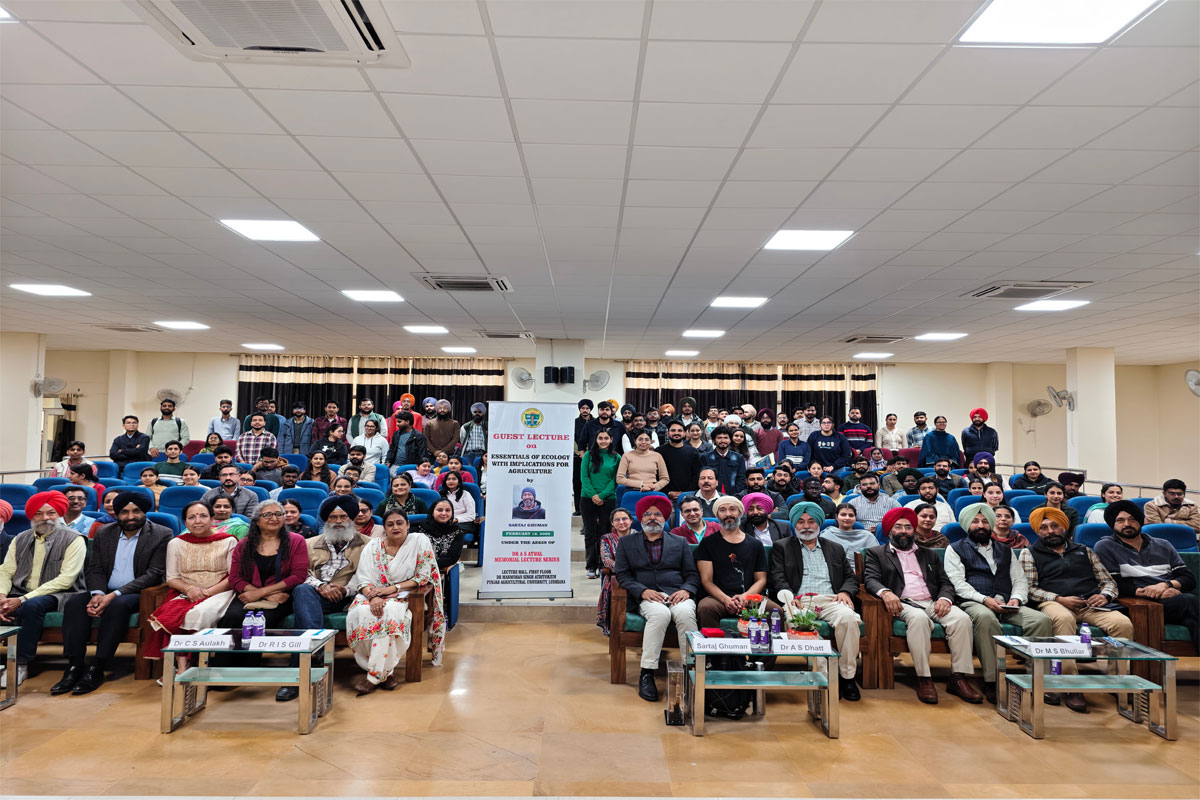
The Department of Entomology at Punjab Agricultural University (PAU) organized a guest lecture titled “Essentials of Ecology with Implications for Agriculture” by Sartaj Ghuman, an ecologist and trained wildlife biologist. The lecture served as a confluence of ecological philosophy and agricultural science. This academic event was conducted under the aegis of the Dr AS Atwal Memorial Lecture Series, honoring the legacy of one of the university’s most revered academic pioneers.
The session was conducted by Dr Manmeet Brar Bhullar, Principal Acarologist-cum-Head, Department of Entomology, who paid a poignant tribute to late Dr AS Atwal and recounted his monumental contributions as an educator, researcher and administrator, specifically emphasizing his visionary success in establishing the ecological work and introduction of the Italian honeybee, Apis mellifera which revolutionized apiculture in the region. An exhibition of books, written by Dr AS Atwal, were also showcased for the audience.
The keynote speaker, Ghuman, a multifaceted artist, farmer, ecologist and wildlife biologist, delivered a deeply productive presentation that beautifully integrated scientific observation and ecological art. He began his presentation by showcasing his intricate paintings of avian species, specifically the Great Hornbill and discussed the functional role of birds as “nature’s original farmers”. He further enriched the technical discourse by sharing his first-hand experiences on Narcondam Island, an isolated volcanic island in the Andaman Sea, and highlighted how specific habitats, when left undisturbed, reached a state of ecological “completeness” and high-carrying capacity that humans often failed to replicate in managed landscapes. While addressing the modern perception of “wastelands” and “grasslands,” he presented evidence that these ecosystems are fully functional units, harboring a vast diversity of specialized organisms and birds that provide invisible but essential ecosystem services to adjacent agricultural fields.
This led to the most resonant moment of the seminar, where the speaker remarked, “The wasteland has always been a complete entity in itself, it is the beholder who remains incomplete, lacking the vision to perceive its inherent wholeness.” Ghuman further supported these philosophical insights with practical examples from his own land, where he practices a “no-intervention” style of cultivation. By allowing natural mulching and self-seeding, he demonstrated that a farm can function as a self-sustaining ecosystem rather than a resource-extractive factory. The lecture was followed by an intellectually stimulating interactive session involving students and faculty.
The session was further enriched by concluding remarks from Dr AS Dhatt, Director of Research, who synthesized Mr Ghuman’s ecological views with the current challenges facing Punjab’s agriculture. Dr Dhatt discussed the urgent need for new ecological parameters to address groundwater depletion and soil health.