




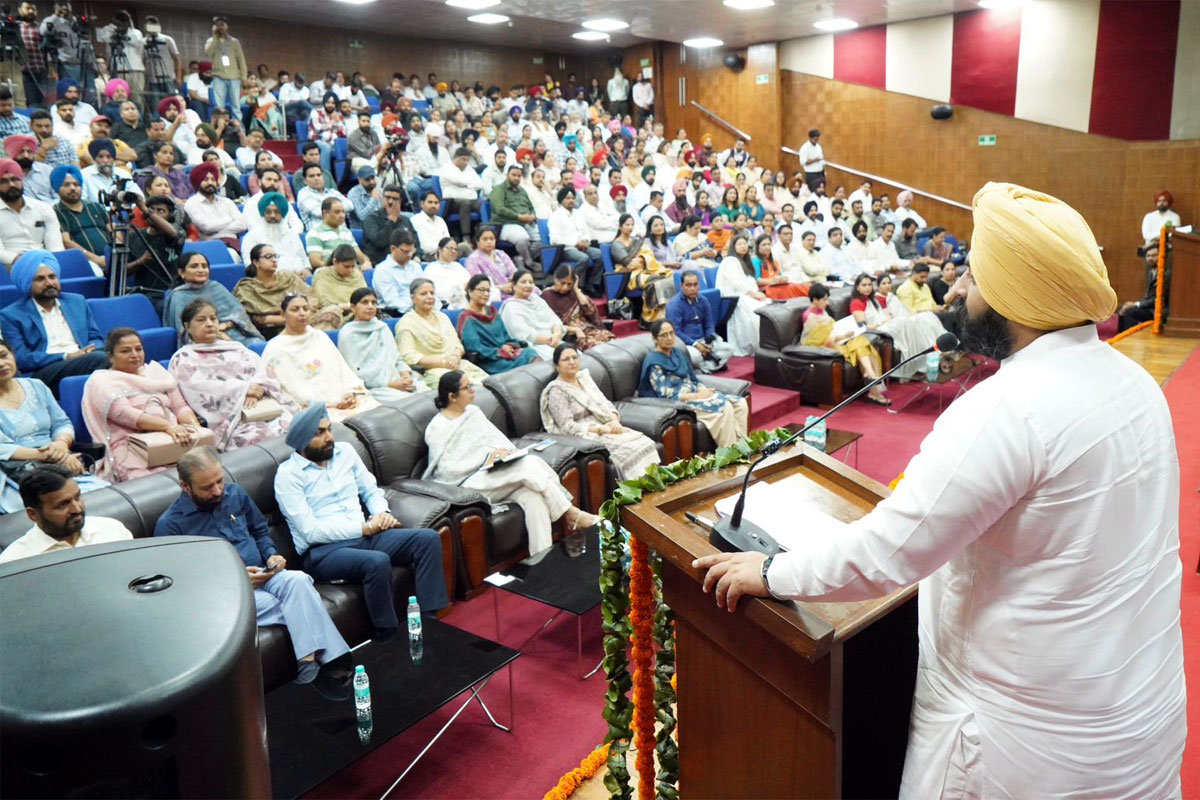
Chandigarh, April 9
Punjab has pushed its Sikhya Kranti (education revolution) into the next phase, with Education Minister Harjot Singh Bains, along with former Delhi Deputy Chief Minister and AAP Punjab Prabhari Manish Sisodia, on Thursday launching Mission Samrath 4.0, a flagship foundational learning programme aimed at achieving global excellence in education. The new phase introduces a state-wide attendance tracking system under which parents will receive daily SMS alerts on their child’s attendance, marking a decisive shift towards real-time accountability and stronger learning continuity in classrooms.
Declaring it as the next big leap in Punjab’s Sikhya Kranti, the Education Minister said Punjab, already ranked No.1 in the PARAKH (Performance Assessment, Review, and Analysis of Knowledge for Holistic Development) survey, is now moving from recognition to results by tightening classroom accountability and scaling proven teaching practices. He underscored that CM Bhagwant Singh Mann has raised the education budget to ₹19,279 crore, ensuring funds reach classrooms rather than remain stuck in files, driving visible transformation from basic infrastructure to measurable learning outcomes across government schools.
Highlighting Punjab’s top rank in the PARAKH Rashtriya Sarvekshan 2024, Bains said that the Punjab Government has introduced the attendance tracking system as part of Mission Samrath 2026–27. He stated, “Parents will receive daily SMS alerts on their child’s attendance, with notifications for every absence, aiming to boost regular attendance, learning continuity and classroom engagement. Any child absent for seven days will trigger a district-level parent contact, while absence beyond 15 days will be flagged to state headquarters. This will ensure both learning continuity and child safety.”
Emphasising the impact of the programme, the Education Minister stated, “Mission Samrath has transformed classroom dynamics. This phase focuses on enhancing teaching quality and accountability through attendance tracking, improved monitoring and sharing the best practices. Our goal is to ensure that every child achieves strong foundational learning.”