



New Delhi, February 19
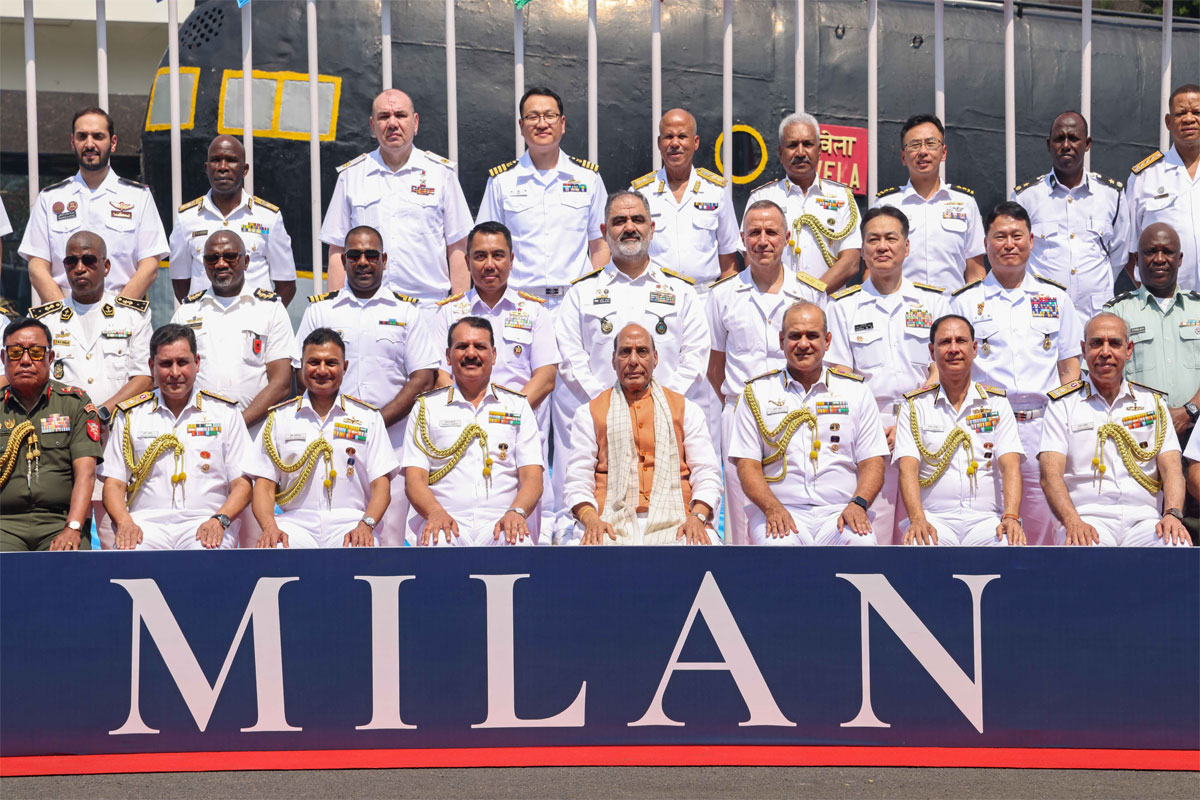
Union Defence Minister Rajnath Singh has called upon the international community to effectively tackle the evolving complex & interconnected challenges at sea while acting in the spirit of mutual respect and give & take. He was addressing Navy Chiefs and Heads of Delegations from 74 countries during the inaugural ceremony of Exercise MILAN at Visakhapatnam, Andhra Pradesh today.
“The role of Navies in international peacemaking has only increased over time. There has been an exponential economic growth during last few decades leading to massive increase in international trade and transport. There has also been a rise in contests for ownership of straits and channels, sometimes causing threats of flare up. Increasing international attention to underwater resources, particularly rare-earth minerals are adding a new dimension to this tension. In addition, there is a need to guard our waters from the nefarious terrorist activities which are spreading tentacles across countries and regions,” said Singh.
Singh asserted that traditional threats coexist with emerging challenges such as piracy, maritime terrorism, illegal fishing, trafficking, cyber vulnerabilities, and disruptions to critical supply chains, adding that climate change is intensifying natural disasters, making humanitarian and disaster relief operations more frequent and demanding. No single navy, however capable, can address these challenges alone, he said, underscoring the need for enhanced cooperation among the Navies to ensure a safer and more secure future.
Singh emphasised that the robust legal framework provided by the UN Convention on the Law of Seas (UNCLOS) to address matters related to international waters can be further strengthened through a comprehensive global naval architecture. He stated that UNCLOS provides a comprehensive and time-tested mechanism for dispute redressal & peaceful co-existence among nations, and the comprehensive global naval architecture would facilitate information sharing, protect links of communications and curbs criminal activities, including terrorism on high seas, along with the usual role of protecting the national boundaries on a global scale.
Pointing out that the established international order is witnessing an upheaval, Singh stated that platforms like MILAN bring together professional expertise, build mutual trust, enhance interoperability, and enable coordinated responses to common challenges. “When our ships sail together, when our sailors train together, and when our commanders deliberate together, we build a shared understanding that transcends geography & politics and provides an opportune moment to deliberate on this idea of cooperation,” he said.
Highlighting that India has long recognised the need of this cooperation, Singh said that shaped by the vision of Security and Growth for All in the Region (SAGAR), the country’s approach to the seas has evolved into the vision of Mutual and Holistic Advancement for Security And Growth Across Regions (MAHASAGAR). This evolution from SAGAR i.e., seas to MAHASAGAR that is oceans reflects India’s deepening commitment to engaging with partners in the region and beyond, he said.
Enumerating India’s efforts to bring the countries together, Singh said, “We have participated regularly in the multilateral engagements and coordinated patrols. Our forces have responded swiftly to humanitarian crises. We have been engaged in many joint Exclusive Economic Zones surveillance and hydrographic assistance and support missions in times of cyclones.” He added that as a trusted Vishwa-Mitra (global friend), India will continue to play a constructive and dependable role in the region, underlining that holistic maritime security and mutual prosperity are indivisible, and can only be achieved through cooperation, trust, and shared commitment among like-minded nations.
Singh described MILAN 2026, with the participation of 74 nations, as a reflection of the confidence the global maritime community places in India as a trusted and responsible maritime partner. “MILAN 2026 seeks to enhance interoperability among navies of partner countries, improve professional competence by sharing of professional experiences and practices, and deepen friendships by evolving bonds of mutual advantage. We aspire to establish an equitable maritime order based on international rules and freedom of navigation in accordance with international law,” he said.