




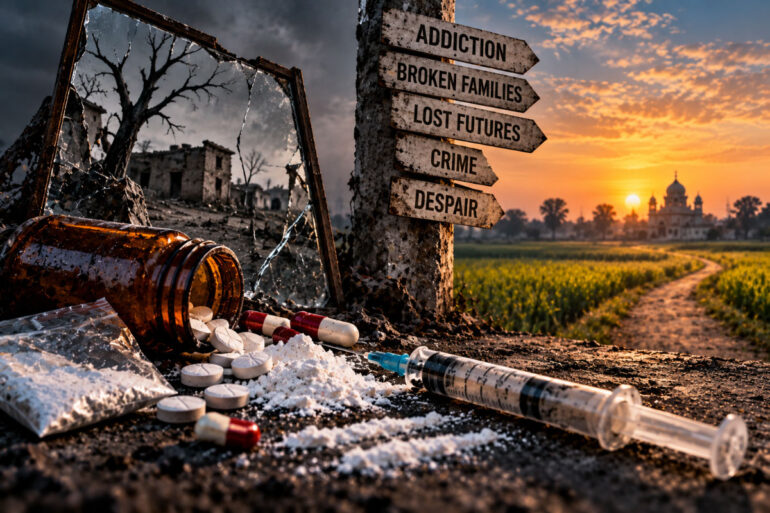
With the Punjab Assembly elections just a few months away, the rampant drug menace has once again moved to the centre stage of political discourse. The Congress, Shiromani Akali Dal and Bharatiya Janata Party are stepping up their attacks on the Bhagwant Mann-led Aam Aadmi Party government, accusing it of failing to fulfil its promise of ending the state’s long-running drug crisis.
The AAP government, on the other hand, has repeatedly maintained that every possible step is being taken to curb the menace and that its sustained campaign against drugs has yielded results. The Opposition, however, remains unconvinced and continues to argue that the reality on the ground tells a different story.
The political irony is that the drug issue has been central to Punjab’s electoral politics for years, with successive governments making ambitious promises to eliminate it. Before the 2017 Assembly elections, then Congress leader Capt Amarinder Singh had announced that if the Congress formed the government, drugs would be wiped out from Punjab within four weeks. The promise became one of the defining slogans of the campaign. Congress subsequently remained in power for a full five years from 2017 to 2022, but the drug menace persisted. The four-week deadline was never realised and the issue remained a major concern when the next Assembly election arrived.
In 2022, the Aam Aadmi Party registered a landslide victory, winning 92 of Punjab’s 117 Assembly seats. AAP too had made strong commitments on the drug issue before coming to power. Bhagwant Mann had categorically stated that drugs would be eradicated from the state within four months. But four-and-a-half years into AAP’s tenure, the Opposition is now using the continuing presence of drugs in Punjab to question whether those promises have been fulfilled.
This is the political backdrop to the BJP’s ongoing 13-day ‘Nasha Mukt Punjab Yatra’. The campaign aims to mobilise people against the drug crisis ahead of the 2027 Assembly elections. Four yatras will together cover around 4,000 kilometres across all 117 Assembly constituencies, with a particular focus on creating awareness about the harmful effects of drugs among the youth. After the yatras conclude, Union Home Minister Amit Shah is scheduled to address a rally in Jalandhar on September 30. The Congress has also been repeatedly targeting the Mann government over the issue, while the Akali Dal has been raising the drug menace at political rallies across the state. Clearly, drugs are once again becoming a major electoral battleground.
Meanwhile, catching users and petty dealers cannot be the measure of success. The larger networks behind the supply chain have to be identified and held accountable. The so-called “big fish” cannot remain beyond the reach of the law while the visible lower levels of the trade continue to be targeted. But enforcement, rehabilitation and economic development must work together. None of them can solve the problem independently.
The political battle is likely to intensify as the elections approach. Punjab has heard enough promises. What it needs now is sustained action that reaches beyond election cycles and addresses both the drug trade and the circumstances that allow it to survive.
(Views expressed are personal.)