




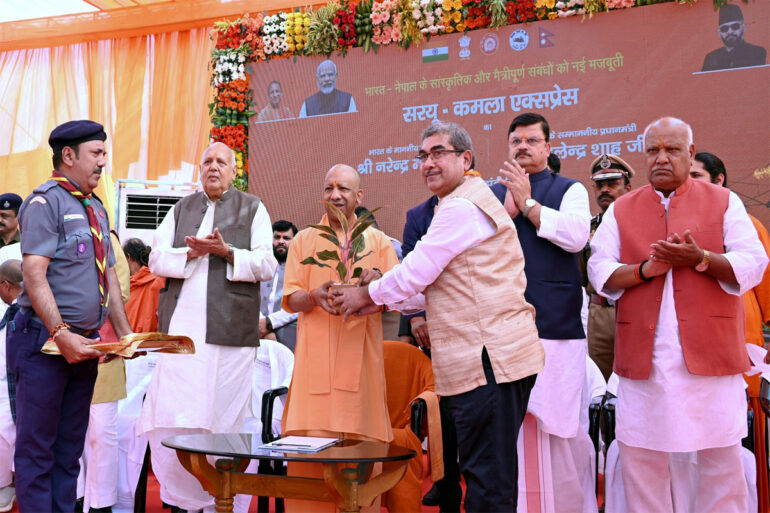
Ayodhya, November 23
The centuries-old cultural, spiritual and familial bond between Ayodhya and Mithila is set to gain fresh momentum through modern rail connectivity. The newly launched Saryu-Kamla Express between Ayodhya Dham and Janakpur Dham is expected to elevate the historic India-Nepal relationship while facilitating smoother travel for pilgrims, traders and citizens of both countries.
Addressing the flagging-off ceremony of the train at Ayodhya Cantt Railway Station, Uttar Pradesh Chief Minister Yogi Adityanath described the service as a reflection of Prime Minister Narendra Modi’s vision of “heritage and development.” He said the connection between Ayodhya, nourished by the sacred waters of the Saryu, and Janakpur, the birthplace of Goddess Sita blessed by the Kamla River, would further deepen the age-old civilizational ties between India and Nepal.
The Chief Minister said the train would enable Nepalese devotees to travel directly to Ayodhya for the darshan of Ram Lalla, while Indian pilgrims would gain easier access to Janakpur Dham for the darshan of Goddess Janaki. He added that the initiative would further strengthen the enduring friendship and mutual trust between the two nations.
Yogi said the relationship between India and Nepal extends far beyond geographical proximity, being deeply rooted in shared faith, culture, traditions and family ties developed over thousands of years. He described it as a “roti-beti” relationship embodied in the Ram-Janaki tradition.
Recalling the journey of Lord Ram and Lakshman to Mithila with Maharishi Vishwamitra and the royal wedding procession from Ayodhya to Janakpur, he noted that these episodes remain alive in the collective memory of both regions and continue to be celebrated during festivals such as Vivah Panchami.
CM said Ayodhya’s residents still regard Janakpur as their in-laws’ home, while people in Mithila view Lord Ram as a revered guest. Referring to the Ram Janaki Vivah Mandap in Janakpur, he said Vivah Panchami is celebrated with great enthusiasm there, just as Ayodhya resonates with traditional wedding songs during the occasion.
The Chief Minister also recalled the contributions of Nepalese saints, youths and devotees during the Ram Janmabhoomi movement and highlighted that hundreds of devotees from Janakpur brought ceremonial gifts to Ayodhya during the consecration ceremony of Ram Lalla.
Shared Spiritual Legacy from Pashupatinath to Kashi Vishwanath
Highlighting the spiritual ties between the two countries, Yogi said Nepal’s Pashupatinath Temple and Kashi Vishwanath in Varanasi have shared a deep spiritual connection for centuries.
He noted that devotees from Uttar Pradesh have traditionally undertaken pilgrimages to Muktinath and Pashupatinath and cited religious customs, such as the offering of khichdi sent from Nepal at the Gorakhnath Temple during Makar Sankranti and pilgrimages to Devi Patan Shakti Peeth during Navratri, as examples of enduring bonds.
The Chief Minister also referred to the shared Buddhist heritage of India and Nepal. While Lord Buddha was born in Lumbini, Nepal, several pivotal sites associated with his life and teachings, including Kapilvastu-Piprahwa, Shravasti, Sarnath and Kushinagar, are located in Uttar Pradesh. He further noted that the sacred Piprahwa relics of Lord Buddha returned to India from Hong Kong in July 2025 after 127 years.
Yogi described the open India-Nepal border as a unique example of mutual trust, facilitating the daily movement of thousands of people for trade, employment, education, healthcare and family purposes.
He said Uttar Pradesh’s seven border districts, including Pilibhit, Lakhimpur Kheri, Bahraich, Shravasti, Balrampur, Siddharthnagar and Maharajganj, share nearly 600 kilometres of border with Nepal.
Referring to Prime Minister Modi’s “Neighbourhood First” policy, he said efforts are underway to strengthen road, digital, energy and rail connectivity between the two nations. The Saryu-Kamla Express, he said, is an important milestone in expanding rail connectivity.
The Chief Minister also recalled the launch of the Janakpur-Ayodhya bus service by Prime Minister Modi from Janaki Temple in Janakpur in 2018, noting that rail connectivity would take bilateral ties to an even higher level.
Yogi highlighted several infrastructure projects aimed at transforming India-Nepal connectivity. He said the state’s first land port at Rupaidiha on the Nepal border is now ready and handles a significant share of exports from India to Nepal.
CM added that plans are in place to develop industrial and logistics corridors around Rupaidiha, while the Barabanki-Bahraich four-lane highway under the Lucknow-Rupaidiha Corridor would substantially cut travel time between Rupaidiha and Nepalgunj.
The Chief Minister also cited the recent inauguration of the 80-km Gorakhpur-Sonauli highway built at a cost of ₹1,450 crore, as well as ongoing work on a four-lane corridor linking the Nepal border with Siddharthnagar, Basti and Prayagraj.
CM said the proposed 750-km six-lane Gorakhpur-Shamli Greenfield Expressway and the under-development Shri Ram-Janaki Marg connecting Ayodhya, Sitamarhi and Janakpur would create new opportunities in trade, tourism and social exchanges.
Modern Connectivity Transforming Ayodhya
The Chief Minister said Ayodhya, once neglected, is now emerging as a major spiritual and tourism hub with world-class infrastructure. The Maharishi Valmiki International Airport has connected the city to national and international destinations, while rail infrastructure has expanded from a single line to double tracks with services such as Vande Bharat and Amrit Bharat trains.
He said the Saryu-Kamla Express would also strengthen the Ramayana Circuit and the Buddhist Circuit. The train will pass through Sitamarhi, regarded as the birthplace of Goddess Sita, where a grand Maa Janaki Temple and spiritual township are being developed at Punaura Dham.
According to the Chief Minister, the train’s halt at 10 key stations across Uttar Pradesh, Bihar and Nepal is expected to spur religious tourism, hospitality, transportation, local handicrafts and trade, creating thousands of employment opportunities in border regions.
CM specifically mentioned women artisans associated with Janakpur’s renowned Mithila painting tradition, saying improved connectivity would help them access larger markets and expand economic opportunities.
Calling Uttar Pradesh the centre of both the Ramayana and Buddhist circuits, which extend into Nepal, Yogi said the Saryu-Kamla Express would serve not merely as a transport link, but as a powerful bridge connecting the shared cultural heritage, religious tourism and economic aspirations of India and Nepal.