




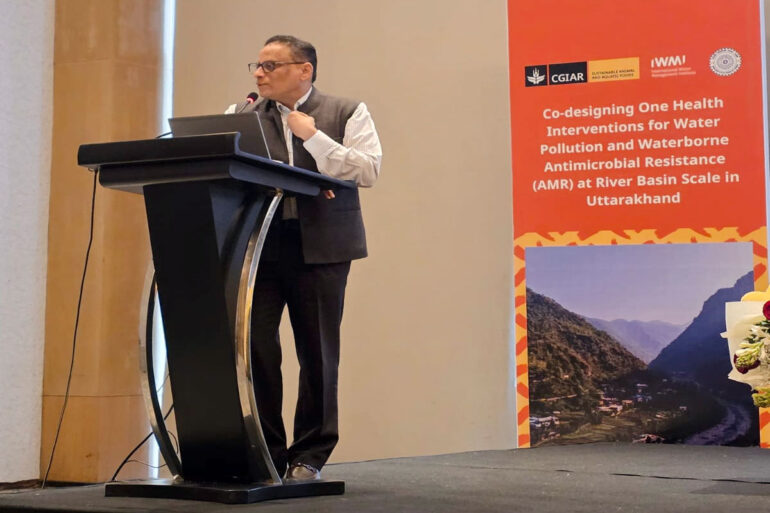
Dehradun, November 23
Efforts to tackle the growing challenges of water pollution and waterborne antimicrobial resistance (AMR) in Uttarakhand are moving beyond problem identification towards concrete action. A two-day workshop titled “Co-designing One Health Interventions for Water Pollution and Waterborne Antimicrobial Resistance (AMR) at River Basin Scale in Uttarakhand” is being organised on November 23-24, 2026, jointly by the International Water Management Institute (IWMI) and the Indian Institute of Technology Roorkee (IIT Roorkee).
The initiative is being undertaken under the CGIAR Sustainable Animal and Aquatic Foods (SAAF) programme and its One Health approach. The workshop focuses on the following key areas:
Identification of Hotspots and Water Systems: Understanding pollution pathways and AMR hotspots in the Song River Basin through water quality monitoring and hydrological modelling using SWAT + BFTM, digital twins, and AI-based forecasting frameworks.
Guiding Framework and Solutions Catalogue: Developing a shared One Health framework for the rejuvenation of the Song River and creating a multi-sectoral catalogue of solutions to reduce waterborne AMR across land, water, and food systems, from source to exposure.
Multi-Departmental Coordination: Deliberating on a joint action plan involving experts from irrigation, pollution control, animal husbandry, public health, river rejuvenation, ICAR, BAIF, WHO, and other research and government institutions.
Addressing the workshop as the chief guest, Dilip Jawalkar, Secretary (Watershed) and Chief Project Director, WMD, stressed that safeguarding and improving the health of the Song River is an urgent priority. He said river rejuvenation should be pursued through effective pollution control measures, water conservation efforts, and close coordination among various departments to protect both river ecology and public health.
Prof. Sumit Sen of IIT Roorkee highlighted the need for integrated modelling approaches to address water pollution and antimicrobial resistance in the Song River Basin and to assess the potential impact of different interventions. During the technical sessions, he presented the current status of the basin and various intervention scenarios using SWAT + BFTM modelling, aimed at enabling the formulation of effective river rejuvenation strategies based on scientific evidence.