




Chandigarh, November 27
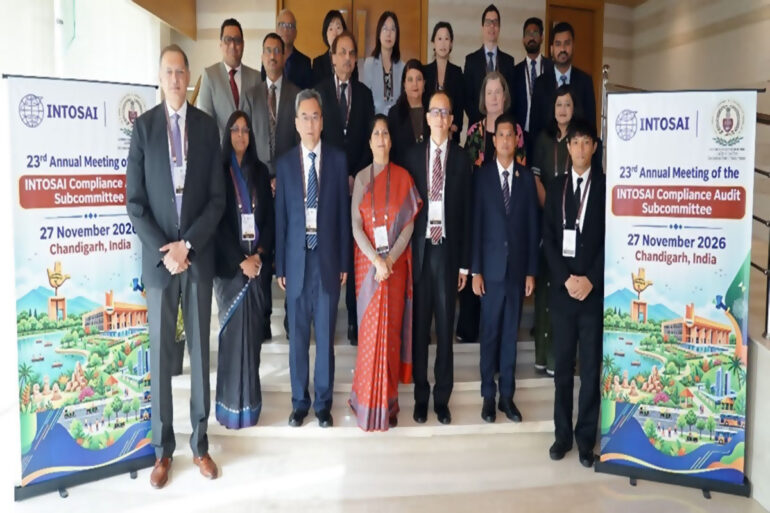
The 23rd Annual Meeting of the International Organization of Supreme Audit Institutions – Compliance Audit Subcommittee (INTOSAI-CAS) concluded successfully in Chandigarh today. The meeting was chaired by Mr. Longjam Siddharth Singh, Additional Deputy Comptroller and Auditor General, SAI India, and brought together representatives from Supreme Audit Institutions (SAIs) across the globe to deliberate on strengthening compliance audit practices, advancing professional standards, and harnessing emerging technologies in public sector auditing. The meeting was attended by 37 participants, including 21 delegates in person and 16 participants through virtual mode, representing 12 SAIs and the INTOSAI Development Initiative (IDI).
Lata Mallikarjuna, Deputy Comptroller & Auditor General (International Relations), welcomed the delegates and reaffirmed SAI India’s commitment to promoting international cooperation among SAIs. She highlighted the growing importance of compliance auditing in ensuring transparency, accountability, and adherence to the rule of law in an increasingly complex governance environment. She also emphasized the role of INTOSAI-CAS in facilitating knowledge sharing and strengthening globally recognized compliance audit practices.
Longjam Siddharth Singh formally inaugurated the meeting and highlighted the strategic priorities of INTOSAI-CAS. The Subcommittee reviewed its activities for 2025–26, including the publication of the Concept Paper on Compliance Audit of Inclusiveness and Equality, adoption of the CAS Work Plan for 2026–2028, release of the CAS Newsletter, and SAI India’s capacity-building initiatives in emerging areas such as Artificial Intelligence (AI), Data Science, and Cybersecurity.
A key highlight of the meeting was SAI India’s presentation on the application of Artificial Intelligence in compliance auditing. Mr. Navneet Gupta, Principal Accountant General, SAI India, presented the proposed Concept Paper on AI in Compliance Auditing, while K. Surjith and Ajay Yeshwanth V, Directors, SAI India, showcased the use of AI-based tools to enhance audit coverage, risk assessment, and evidence-based assurance across various sectors. They also highlighted SAI India’s initiatives in developing domain-specific Large Language Models for audit applications.
The meeting also featured discussions on major INTOSAI initiatives. Michel Cohen of the Federal Court of Accounts of Brazil briefed members on the developments of the Professional Standards Committee (PSC) and progress under the Strategic Development Plan (SDP) 2023–2028. Shefali Andaleeb, Director General, SAI India, presented the progress of the ‘G’ Initiative aimed at strengthening the Framework for INTOSAI Guidance (GUIDs). Md Shofiqul Islam from the INTOSAI Development Initiative (IDI) highlighted opportunities for enhanced CAS–IDI cooperation, including competency development initiatives for compliance auditors. Discussions were also held on aligning compliance audit pronouncements with the revised ISSAI 140 on Quality Management with a comprehensive presentation on the same by Ketki Borkar, Deputy Director, SAI India.
Representatives from member SAIs shared their experiences and good practices in compliance auditing. The Federal Court of Accounts of Brazil presented its digital audit workflow and approach towards strengthening assurance engagements. The National Audit Office of China shared its risk-based quality management framework, while the Office of the Auditor General of Norway highlighted its approach to promoting accountability, transparency, and integrity in public administration.
The 23rd INTOSAI-CAS Meeting will be followed by the Second Annual Meeting of the Asian Organisation of Supreme Audit Institutions – Working Group on IT Audit and Data Analytics (ASOSAI WGITA&DA) and a Seminar on “Strategic Role of SAIs in Digital Governance” on 28 November 2026 in Chandigarh. Under the leadership of K. Sanjay Murthy, Comptroller and Auditor General of India, SAI India continues to contribute to the advancement of global public sector auditing practices through innovation, professional cooperation, and knowledge sharing among SAIs.