







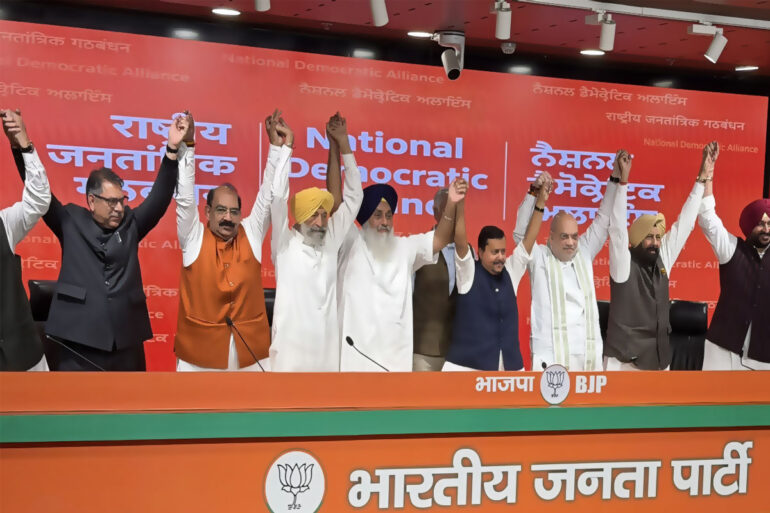
In the complex power dynamics of Punjab politics, few partnerships have carried as much structural weight as the alliance between the Shiromani Akali Dal (SAD) and the Bharatiya Janata Party (BJP). Imagining a scenario where both parties reconcile their differences and forge a fresh electoral alliance—especially with just three months remaining before the Punjab Assembly elections—represents a massive political realignment. This potential reunion would not merely re-stitch a historic pact; it would fundamentally restructure the state’s multi-cornered electoral arena.
The Historic Foundations: The Vajpayee Era Blueprint
To understand the weight of this hypothetical reunion, one must revisit its genesis. The formal alliance was cemented in the late 1990s under the leadership of Parkash Singh Badal and Atal Bihari Vajpayee. Dubbed the ‘Nau-Maas da Rishta’ (a bond as close as flesh and nail), the coalition was designed as more than a transactional electoral arrangement. It served as a vital social bridge in post-militancy Punjab, uniting the rural, predominantly Sikh agrarian base represented by the Akali Dal with the urban Hindu electorate anchored by the BJP. This socio-political coalition brought stability to the state, steering it to complete multiple full terms in office—most notably providing a decade of continuous governance from 2007 to 2017.
A Partnership with Defined Political Roles
Throughout these decades, the power-sharing arrangement remained clearly defined. The Shiromani Akali Dal (SAD) served as the senior partner in Punjab politics, contesting 94 Assembly seats while the Bharatiya Janata Party (BJP) contested 23 seats. In Lok Sabha elections, the seat-sharing formula allocated 10 seats to the SAD and 3 seats to the BJP. While the SAD primarily shaped rural and agrarian policies, the BJP maintained its influence in urban constituencies and played a key role in representing Punjab’s interests at the Centre.
The Breaking Point: Farm Laws Trigger Split & Harsimrat Quits Union Cabinet
The alliance broke in September 2020 over the passage of the Centre’s controversial three farm laws. Facing immense pressure from its core rural constituency—farmers in Punjab’s agrarian heartland—the Akali Dal was forced to make a decisive choice. Harsimrat Kaur Badal, who served as Union Minister for Food Processing Industries in Prime Minister Narendra Modi’s cabinet, submitted her resignation in protest. Shortly thereafter, SAD formally snapped its 23-year-old ties with the National Democratic Alliance (NDA). The split marked one of the most significant ruptures in contemporary coalition politics, leaving SAD politically isolated in rural Punjab and forcing the BJP to try and expand its independent footprint across a state where it lacked widespread rural infrastructure.
The Significance of a Pre-Election Reunion
Fast-forward to the present: with barely three months to go before the state polls, a renewed SAD–BJP alliance carries profound strategic implications.
Re-establishing Social Harmony & Electoral Arithmetic
Separately, both parties faced sharp limitations. In recent elections, the BJP’s appeal remained largely restricted to urban centers, while SAD struggled to retain its dominant share of the Panthic and rural vote amidst fierce competition from the Aam Aadmi Party (AAP) and Congress. Re-uniting is likely to restore the Hindu-Sikh social coalition, combining urban economic hubs with rural agricultural belts to create a formidable voting block.
Countering the Incumbent Realities
The ruling AAP, which swept the 2022 elections, along with a revived Congress, benefits heavily when the opposition vote is fragmented. A consolidated SAD–BJP front instantly changes the narrative from a scattered multi-cornered contest into a streamlined, high-stakes battle.
Federal Synergy
For SAD, regaining proximity to central power could translate into developmental guarantees for Punjab’s debt-ridden economy and agrarian sector. For the BJP, partnering with a veteran regional ally restores stability in a sensitive border state where national security and economic growth go hand-in-hand.
Conclusion
With the SAD and the BJP putting past grievances behind them and re-entering the political battlefield together, the move would reflect a pragmatism driven by political survival. While convincing Punjab’s agrarian electorate that old differences have genuinely been resolved remains a formidable challenge, the structural necessity of such an alliance could significantly reshape the state’s political landscape, setting the stage for one of the most fiercely contested Assembly elections in Punjab’s history.
(The author is the Editor of the website www.thenewsgateway.com. Views expressed are personal.)