




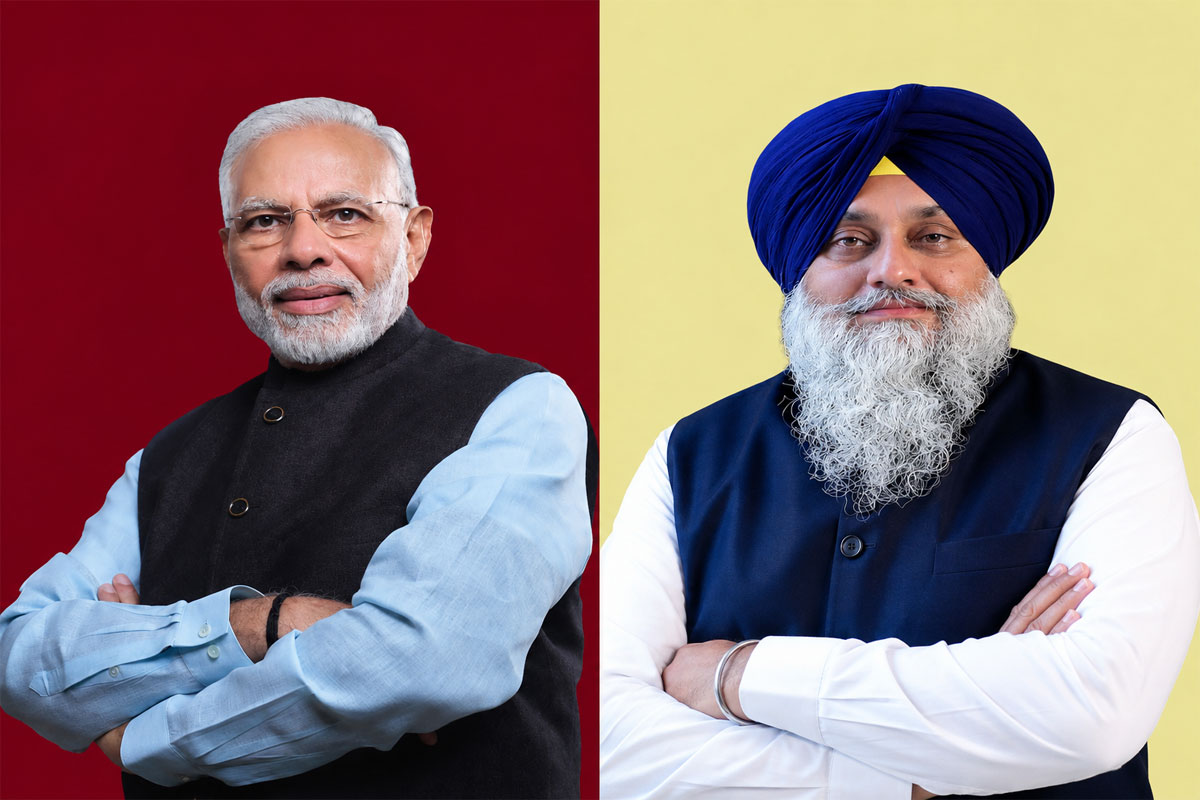
For a long time now, the announcement of the alliance between the Shiromani Akali Dal and the Bharatiya Janata Party was just a matter of time. It eventually happened on Tuesday coinciding with the Guru Purab (birth anniversary) of Guru Nanak.
That the two parties decided to announce the alliance on the sacred occasion of the Guru Purab conveys clear signal that the two parties are keen to appeal to the panthic constituency, which has slipped out from the Akalis’ influence.
Both, the SAD and the BJP are not the same as they were in 2012, when they fought the last winning electoral battle together. Although they were together in 2017 also, they fared badly. By 2022 they had parted ways over the three central farm laws, which the BJP government later withdrew.
The SAD base has since eroded, while the BJP has made substantial gains in Punjab. Both the parties faced a hostile electorate in 2022 when they touched their nadir. The BJP is no longer an anathema for the Punjabis, particularly the Jatt peasantry in the countryside. The anger against the Akalis that prevailed in 2022, has gone. The party has managed to retrieve and redeem substantial section of its estranged cadre back to its fold.
The anti-incumbency against the Aam Aadmi Party government will also contribute to gains for the SAD in the rural areas. The SAD will, at the same time, have to confront the challenge posed by the Waris Punjab De (WPD) of jailed MP Amritpal. But the WPD will equally damage the ruling AAP in the rural areas.
Based on the statistics of the 2024 General Elections in Punjab, the BJP and the SAD led from 36 assembly segments between themselves. The two parties came second in about two dozen assembly segments within the parliamentary constituency. If the votes of the two parties were added up in the assembly segments none of them led from, the combined lead was in about 58 assembly segments. Their combined vote share was 32 percent in 2024, while the AAP and the Congress were at around 25 percent each.
The assembly and the parliamentary elections are fought on completely different premises. And the parliamentary results don’t necessarily repeat in the assembly elections and that too when the time gap is almost two and a half years, half term of the tenure. But these are strong indicators.
Union Home Minister Amit Shah is rightly believed to be the ace strategist when it comes to fighting the elections. Even his rivals acknowledge in private his capability to deliver the victories, although in public the BJP’s victory is attributed (by its rivals) to electoral theft.
Similarly, Sukhbir Badal is also considered to be a good ‘election manager’ who knows the nuances quite well. Shah and Sukhbir can prove to be a formidable combo in Punjab. More so when the BJP is quite keen to bring Punjab into NDA’s kitty, resources will not be a problem for them.
The Congress, which till now had a definite edge, will now have to rethink its strategy. The party still has not managed to fight off the perception of the “house divided against itself”. Two of its former MLAs, Raminder Singh Amla and Hardayal Kambhoj left the party joining the SAD and the BJP respectively. Since the alliance has already been formalized between the SAD and the BJP, the Congress, as well as the AAP, will need to keep a watch on its leaders who may feel tempted to jump into the alliance. Three AAP MLAs have already joined the BJP a few weeks ago.
The Congress is now faced with a dual challenge; one from the alliance and the second from the perception of factionalism which is refusing to recede. The AAP already is faced with anti-incumbency.
Irrespective of what the final outcome will be in 2027, right now it looks to be “advantage Akali-BJP”.