




Patiala, November 2
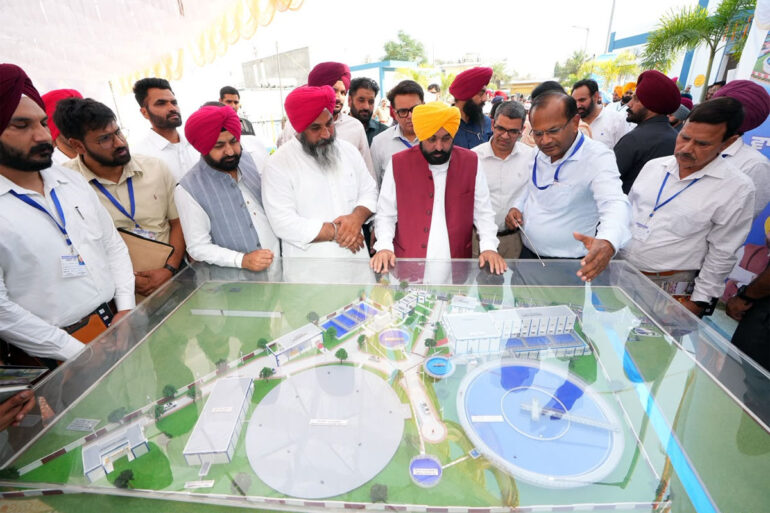
Chief Minister Bhagwant Singh Mann on Monday dedicated two state-of-the-art Water Treatment Plants, built at a cost of ₹432.65 crore at village Mandoli in Ghanaour constituency of Patiala, providing a major boost to access to safe drinking water across the region. The project will supply clean canal water daily to 316 villages across five Assembly constituencies, covering 4.50 lakh residents and 70,000 households through a 752-kilometre pipeline network. Besides addressing the groundwater crisis and tackling contamination, including fluoride, the project will provide a long-term solution to drinking water challenges, reaffirming the Punjab Government’s commitment to making clean drinking water accessible to every household.
Sharing a few snippets from this occasion, Mann stated: “Today, dedicated two new Water Treatment Plants built at a cost of ₹432 crore to the people at village Mandoli in Patiala. Now, 316 villages across five Assembly constituencies and 75,000 households will receive clean canal drinking water every day. This project will provide a permanent solution to the problem of contaminated water, including fluoride contamination, and will serve as a lifeline for residents. The health of Punjabis remains our top priority.”
Addressing the gathering, Mann said, “Today is a historic day for the districts of Patiala and Fatehgarh Sahib as three major projects worth around ₹432 crore is being dedicated to the people. Access to clean drinking water is directly linked to public health, and these projects will prove to be a lifeline for the people. Due to the high concentration of fluoride and heavy metals in groundwater in both districts, the decision has been taken to supply canal-based drinking water.”
The Chief Minister said, “Water treatment plants have been established at Mandoli and Pabri to treat canal water, and these plants have a combined capacity to treat 69 million litres of water every day. The Mandoli plant in Patiala district has been established at a cost of ₹266.20 crore, while the Pabri plant in Patiala district has been set up at a cost of ₹166.46 crore. These projects will benefit 316 villages across six Assembly constituencies, and more than 5 lakh people living in approximately 75,000 households will receive an uninterrupted supply of potable canal water.”
Mann said, “Out of the 316 villages, 250 are those where groundwater quality is affected, while the remaining 158 villages fall along the transmission route. These projects are particularly significant as they will reduce dependence on groundwater and help conserve underground water resources. Water testing laboratories have been established at all three project sites, and water samples are tested daily, both before and after the treatment process.”
The Chief Minister said, “It is unfortunate that even 80 years after Independence, people in these villages were still deprived of the basic necessity of clean drinking water. This work should have been completed decades ago, but previous governments completely ignored the needs of Punjab’s people. We have taken up this long-pending responsibility and ensured access to clean drinking water for thousands of families.”
Mann said, “Testing reports of these laboratories are sent every month to the State-Level Water Testing Laboratory. A key feature of these projects is the installation of a Supervisory Control and Data Acquisition (SCADA) system at the water treatment plants and every water storage tank to ensure continuous monitoring and quality control of the water supply.”
The Chief Minister said, “A total of 752 kilometres of DI transmission pipeline has been laid to ensure the supply of water to every household. Additionally, 1,216 kilometres of pipelines have been upgraded across the 316 villages. Uninterrupted water supply is now being ensured through 322 water storage tanks under the existing water supply schemes in these villages.”
Mann further said, “The company that has executed these projects has also been entrusted with their operation and maintenance for a period of 10 years. Water Supply and Sanitation Committees have been constituted in all 316 villages to ensure community participation, effective operation and monitoring of the projects.”