


By Ravee S Aahluwalia
In an age of instant communication, the distance between “local” and “global” has almost disappeared. A remark made in a small gathering, a policy taken in a town, or a conflict within a community can quickly echo across borders through media and technology. What we do in our immediate surroundings does not stay confined there; it becomes part of a much larger story.
Identities, Traditions and Fear
Across many societies today, visible lines of separation are hard to miss. People increasingly organize their lives around identities such as religion, caste, community, gender, or region. These identities can be sources of comfort, belonging, and pride. But when they become the primary way we see one another, they can also harden into boundaries that limit dialogue and mutual understanding.
It is worth recalling that many of these identities are rooted in the efforts of spiritual leaders, philosophers, and reformers who tried to uplift and guide people in their specific contexts. They observed the realities of their time, understood the needs of their communities, and communicated profound insights in language that ordinary people could grasp. Over time, these teachings gave rise to diverse traditions and communities, each with its own practices and symbols.
Essence Versus Outer Forms
Over centuries, however, the outer forms of these traditions have sometimes overshadowed their inner essence. The core messages—compassion, dignity, shared humanity—can get lost behind layers of interpretation, ritual, and institutional interests. Instead of focusing on common values, people may become more invested in defending their own versions of truth, often with deep sincerity but also with a degree of rigidity.
Fear as a Human Experience
In defending these circles of belief or identity, we may unintentionally create barriers that are difficult to cross. When someone tries to question, reinterpret, or simply understand what lies beyond those boundaries, it can be seen as a challenge or even an attack. At the root of much of this reaction is a very human experience: fear.
Fear, in itself, is not wrong. It is a natural response, shaped by our upbringing, history, and environment. Families, educational systems, media, and social structures all play a role in shaping what we fear and whom we trust. Some people, with support, reflection, and exposure to diverse perspectives, gradually learn to move beyond certain fears. Others may continue to live under the influence of fear for much of their lives, often without fully realizing it.
Communities, Nations and Division
Communities and institutions can also, sometimes unintentionally, reinforce fear. Narratives about “outsiders,” threats to identity, or potential loss of status can make groups more inward‑looking and defensive. While this may create short‑term cohesion, it often deepens long‑term divisions.
This pattern does not stop at the level of individuals or communities. On the global stage, nations also struggle with questions of identity, security, and influence. Policy choices made in the name of national interest can sometimes reflect underlying fears about being overshadowed, marginalized, or dominated. The result can be an international environment where suspicion often overshadows trust, and competition takes precedence over cooperation.
Local Mindsets, Global Atmosphere
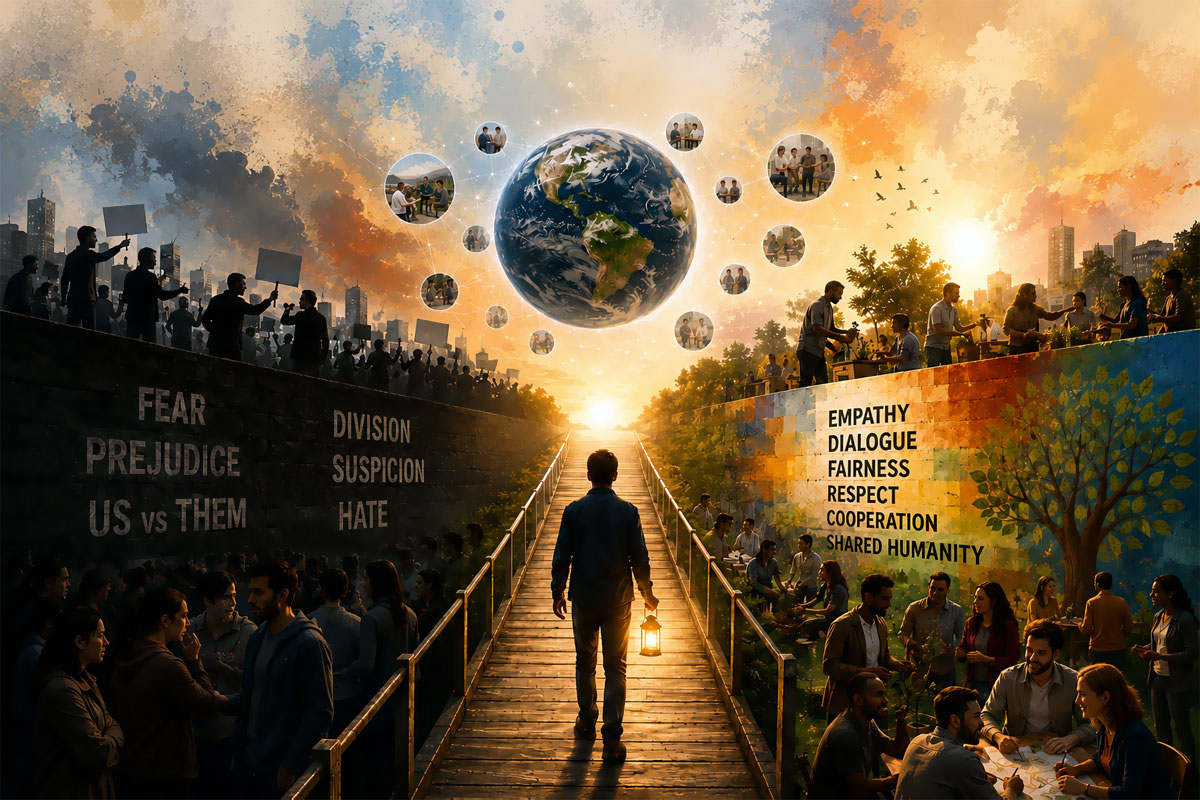
Yet, beneath these complex dynamics, a basic truth remains: the mindset we cultivate locally shapes the atmosphere globally. If hostility, prejudice, and exclusion are normalized in our local spaces, they contribute to a wider culture of polarization. If, instead, we nurture habits of listening, fairness, and empathy, we add to a global climate that is more open to cooperation and peace.
Shared Ethical Teachings and Human Values
Across different cultures and traditions, there is a recurring theme in ethical and spiritual teachings: all human beings possess inherent worth. Whether expressed in ideas such as universal brotherhood, human dignity, or the presence of the divine within each person, the message points toward equality and respect. At their best, these teachings encourage people to see beyond narrow interests and recognize a common bond.
In daily life, however, conversations around faith, ideology, or identity can quickly become competitive. People may feel pressure to demonstrate that their belief, path, or community is the most authentic, the most correct, or the most deserving of recognition. When that happens, we risk drifting away from the shared values that almost all traditions promote—kindness, honesty, humility, and care for others.
Humanity at the Center of Change
The challenge, therefore, is not to erase our identities, but to place them in a broader frame. Our languages, customs, and beliefs add richness to the human picture; they do not have to become walls. Being proud of one’s heritage can go hand in hand with acknowledging that others, too, have meaningful stories and truths. Being rooted does not mean being closed.
In practical terms, this means putting “being human” at the center of our interactions. A respectful conversation with a neighbor from a different background, a fair decision taken in a local institution, a policy that includes rather than excludes—these may appear small, but they carry weight. The world is, after all, made up of countless such decisions and interactions.
Change towards a more peaceful and just world is not driven only by high‑level summits or international agreements, important as they are. It is also driven by what happens in local markets, schools, offices, and homes. When people choose cooperation over confrontation in these spaces, they lay the groundwork for broader harmony.
Local Actions, Global Reflections
The question each of us can ask is simple: Are my actions deepening divides or building bridges? Am I acting from habit and fear, or from reflection and a recognition of shared humanity?
The global picture we see on our screens every day is, in many ways, a mirror of local realities multiplied many times over. If we want that picture to change, our efforts must begin where we stand. Whatever we do locally—through our words, choices, and attitudes—does have an impact beyond what we can immediately see. The kind of world we collectively create will be shaped, to a large extent, by the kind of human beings we choose to be in our everyday lives.