

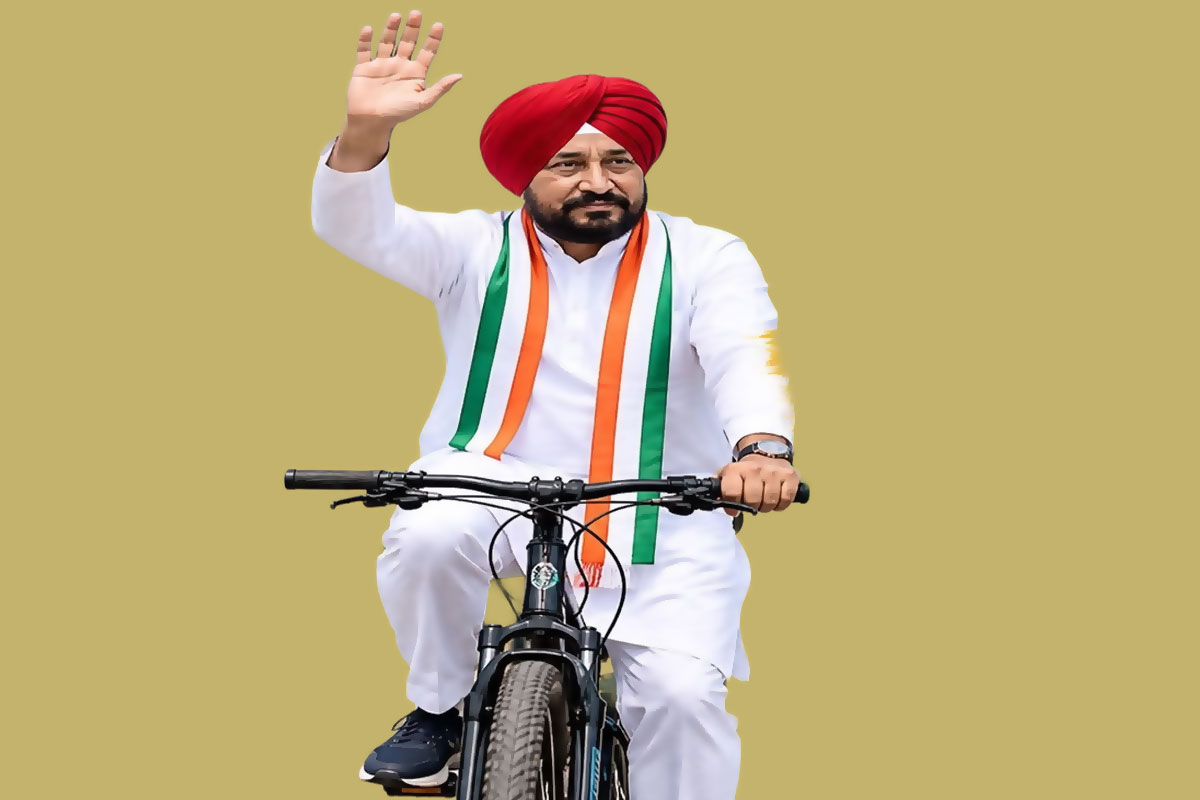
With the Punjab Assembly elections barely three months away, Congress MP and former Chief Minister Charanjit Singh Channi is preparing to take his political battle directly to the streets. His eight-day, 625-km-long ‘Jawani Sambhal Cycle Yatra’, scheduled to commence from Chamkaur Sahib on November 12, is being viewed as more than just an outreach exercise. By choosing the bicycle as his political vehicle, Channi appears keen to strike a direct chord with Punjab’s youth, bring pressing public concerns into the political spotlight and perhaps more importantly, reinforce his own position within the state Congress leadership.
The campaign is expected to focus on issues that have considerable resonance among Punjab’s electorate, particularly unemployment, the drug menace and the deteriorating law-and-order situation. At a time when political parties are gearing up for an intensely contested electoral battle, Channi’s decision to undertake an extensive journey across the state has already generated considerable political interest. However, there is another dimension to this exercise that makes it particularly intriguing: the striking resemblance it bears to the cycle yatras undertaken by former Haryana Congress president Ashok Tanwar in 2018.
Under the banner of ‘Haryana Bachao, Parivartan Lao’, Tanwar had embarked on extensive bicycle campaigns across Haryana, seeking to establish a direct connect with ordinary citizens and grassroots Congress workers. His yatras were designed to mobilise public opinion against the BJP government, with unemployment, law and order and other governance-related issues featuring prominently in his political messaging. But the exercise was not merely an anti-government campaign. It was also an unmistakable attempt by Tanwar to consolidate his political position, demonstrate his mass appeal and establish himself as the principal Congress face in Haryana ahead of the 2019 Assembly elections.
The parallels with Channi’s current initiative are difficult to overlook. Both are prominent Dalit leaders of the Congress, and both chose the bicycle as a medium of political communication in the run-up to crucial Assembly elections. Both sought to bypass the limitations of conventional political rallies and reach people at the grassroots through sustained public engagement. Their campaigns also carried a dual message: challenge the ruling establishment on issues of public concern while simultaneously demonstrating their own organisational strength and political relevance within the Congress.
There is, however, a significant political context to these similarities. When Tanwar launched his cycle yatras in 2018, he was confronting challenges on two fronts. Apart from taking on the BJP government, he was also grappling with factionalism within the Haryana Congress, where competing leadership claims had made the task of establishing his authority increasingly difficult. His extensive public outreach was, therefore, as much about strengthening his political credentials within the party as it was about challenging the government.
Channi finds himself in a somewhat similar political environment. Despite having occupied the state’s highest executive office, his position within the Punjab Congress remains part of a larger leadership equation involving several influential party figures. His proposed yatra can consequently be interpreted as an effort to reclaim political space, reconnect with the party’s grassroots constituency and demonstrate that he continues to command considerable public support. It also provides him with an opportunity to project himself as a leader willing to take the political fight beyond party offices and press conferences.
The symbolism of the bicycle is equally significant. Unlike elaborate political roadshows, cavalcades and high-profile public meetings, a cycle yatra conveys simplicity, accessibility and a willingness to undertake a physically demanding journey. It allows a politician to project himself as being among the people rather than merely addressing them from a stage. In an election where issues affecting ordinary households, particularly unemployed youth, are likely to occupy centre stage, such symbolism can prove politically valuable.
Yet, the real test for Channi will not be the distance covered or the crowds gathered along the route. It will be whether the exercise translates into sustained political mobilisation, strengthens the Congress organisation and helps him emerge with greater authority in the party’s leadership structure. Tanwar’s experience also offers an important reminder that an impressive public outreach campaign does not automatically guarantee political dominance or electoral success.
Whether Channi’s ‘Jawani Sambhal Cycle Yatra’ produces the desired political dividends remains to be seen. Nevertheless, the resemblance to Tanwar’s 2018 experiment is unmistakable. Two prominent Dalit Congress leaders, facing crucial electoral battles and navigating internal leadership challenges, have chosen remarkably similar routes to reach the electorate. For Channi, therefore, the journey may be about much more than reaching Punjab’s youth. It could also be about establishing who he is in the Congress’s own political pecking order.
(Views expressed are personal.)