




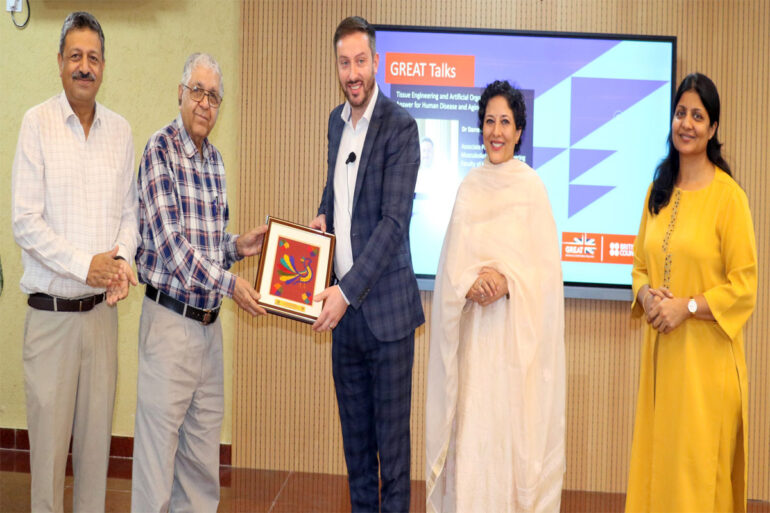
Chandigarh, October 14
From helping patients regain movement after an injury to exploring ways to repair damaged bones, cartilage and muscles, advances in tissue engineering are opening new possibilities in healthcare. These developments were the focus of a science lecture by Dr. Darren J. Player, Associate Professor of Musculoskeletal Bioengineering at University College London (UCL), United Kingdom, at Panjab University, Chandigarh, where researchers and students explored how bioengineering could shape the future of regenerative medicine.
The lecture, titled “Tissue Engineering and Artificial Organs: Sci-Fi or the Answer for Human Diseases and Aging?”, was organised under the GREAT Talks series of the British Council as part of the third Technology Colloquium Series. The event was organised in collaboration with the PU-IIT Ropar Regional Accelerator for Holistic Innovations Foundation (PI-RAHI), the Northern Region Science and Technology Cluster established under the aegis of the Office of the Principal Scientific Adviser to the Government of India, the Dr. Harvansh Singh Judge Institute of Dental Sciences and Hospital, and the Chandigarh Citizens Foundation.
More than 100 researchers, students and innovators from interdisciplinary fields, along with academic experts and representatives of the British Council and the India-UK scientific engagement ecosystem.
Those present included Prof. Rajat Sandhir, Director, PI-RAHI; Prof. Arun Grover, former Vice Chancellor of Panjab University; and Prof. Savita Parashar of the Dental Institute, along with faculty members and other distinguished participants.
Dr. Player discussed how bioengineering and tissue engineering research could contribute to the treatment and recovery of patients with musculoskeletal disorders and orthopaedic injuries. The discussion covered emerging approaches to muscle regeneration, bone and cartilage repair, and the restoration of tissue function, including their potential to improve mobility and recovery among patients experiencing difficulty walking following injury or disease.
The lecture also explored research into engineered tissues and biological substitutes for organs such as the kidneys, liver and heart. These approaches aim to improve understanding of tissue repair and regeneration and could, in time, contribute to new treatments for organ damage. While many applications remain at the research or experimental stage, advances in regenerative medicine are creating new avenues for clinical investigation.
Among the key themes were the possibility of growing muscle tissue in laboratories, restoring movement after injury, and investigating light-based therapies to support healing. Dr. Player also discussed how scientists study highly regenerative animals, such as the axolotl, to understand the biological mechanisms that enable tissue repair and regeneration.
The session examined how biology, engineering, materials science and medicine can work together to develop new approaches to healthcare. From repairing damaged joints and cartilage to investigating ways to restore the function of injured tissues, these interdisciplinary advances could eventually support better treatment options and improve patients’ quality of life.
The session highlighted how areas of research once associated with science fiction are now being investigated in laboratories worldwide, while underlining the need for continued scientific validation and clinical trials before emerging tissue-engineering approaches can become routine treatments.
The PI-RAHI Technology Colloquium Series is designed to encourage knowledge exchange at the intersection of scientific research, technology translation and entrepreneurship. It provides a platform for students and researchers to engage with scientists, technology leaders and innovators on emerging technologies and their potential applications.
Through the GREAT Talks collaboration, PI-RAHI and its institutional partners seek to strengthen interdisciplinary research, promote links between academia, industry and clinical practice, and encourage the translation of scientific advances into solutions that address real-world healthcare needs.