




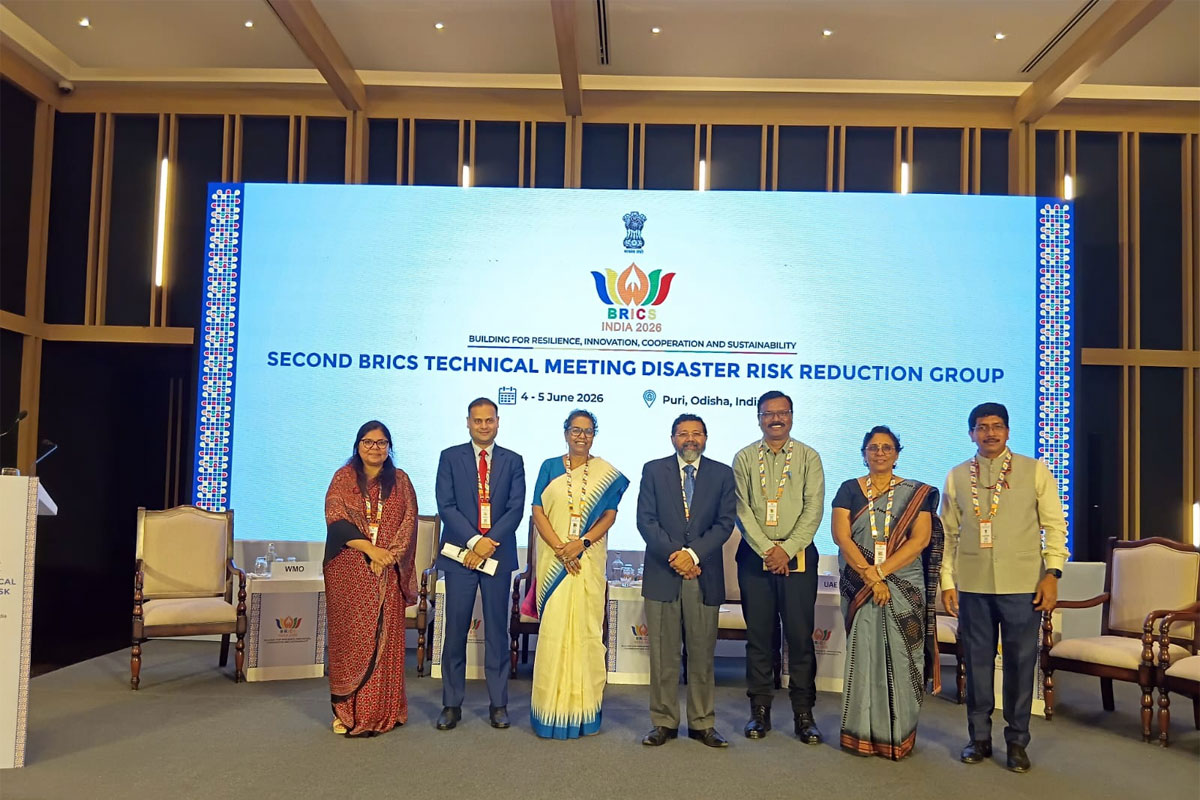
Dehradun, June 7
Highly vulnerable to natural disasters and rain-induced crises, Uttarakhand has once again established a strong identity in disaster management—not only at the national but also at the international level. Under India’s chairmanship, the state’s disaster management model was widely appreciated at the second technical meeting of the BRICS Disaster Risk Reduction (DRR) Working Group, held in Puri, Odisha from June 3–5, 2026.
The three-day meeting brought together senior officials, technical experts, and policymakers from 11 BRICS member and partner countries, including Brazil, Russia, India, China, South Africa, Egypt, Ethiopia, Iran, Saudi Arabia, the United Arab Emirates, and Indonesia. The objective was to exchange experiences on disaster risk reduction, resilient infrastructure, community-based early warning systems, forecast-driven rapid response mechanisms and sustainable financial arrangements for disaster management.
Countries presented their innovations and successful models in disaster management. Representing Uttarakhand, SDRF Commandant Arpan Yaduvanshi (IPS) and ULMMSC Director Shantanu Sarkar showcased the state’s achievements under the leadership of the State Disaster Management Authority. Their presentation highlighted disaster risk reduction, preparedness, capacity building, technological innovations, and effective response mechanisms.
They elaborated on Uttarakhand’s geographical complexities—Himalayan conditions, landslides, heavy rainfall, glacial lakes, road blockages, and pilgrimage-related risks. The state’s multi-agency coordination system, early warning mechanisms, and rapid relief-and-rescue arrangements were also emphasized.
The Silkyara Tunnel Rescue Operation and Dharali disaster management efforts were presented as exemplary models. Delegates praised these operations as outstanding examples of patience, technology, administrative coordination, and humanitarian sensitivity in challenging terrain.
The state’s early warning systems, risk reduction measures, and inter-departmental coordination received special recognition, while SDRF’s swift and effective response capacity was highlighted as a benchmark disaster response model.
SDRF Commandant Arpan Yaduvanshi said, “Thanks to Chief Minister Pushkar Singh Dhami’s sensitive and proactive approach to disaster management, risk reduction, preparedness, capacity building, and inter-agency coordination are being continuously strengthened. Through scientific planning, efficient administration, and timely decision-making, efforts are being made to minimize the impact of disasters.” He added that in a mountainous state like Uttarakhand, disaster management cannot be limited to relief and rescue alone. “Preparedness, community participation, availability of trained forces, and technology-based monitoring systems are absolutely essential.”