




Dehradun, November 2
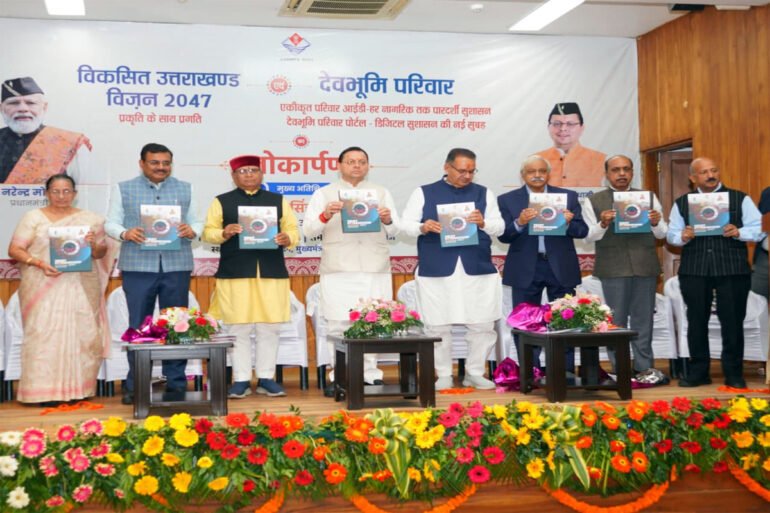
Uttarakhand Chief Minister Pushkar Singh Dhami on Monday launched the ‘Devbhoomi Parivar Portal’ and unveiled the ‘Viksit Uttarakhand Vision-2047’ document at the Mukhya Sevak Sadan in the Chief Minister’s Camp Office. He said both initiatives would play a vital role in strengthening good governance, ensuring that government schemes reach eligible beneficiaries, and providing a clear roadmap for the state’s long-term development.
The Chief Minister said the true measure of a government’s success is not merely the formulation of schemes but ensuring that their benefits reach eligible citizens and bring positive changes to their lives. He noted that many deserving individuals fail to avail themselves of government schemes due to lack of information, while citizens are often required to repeatedly submit documents and visit multiple departments for the same purpose. Through the Devbhoomi Parivar Portal, the government aims to address these challenges and make public services more accessible, transparent, and citizen-centric.
Dhami said that under the leadership of Prime Minister Narendra Modi, India is progressing towards the goal of becoming a developed nation by 2047. Recalling the Prime Minister’s statement from the sacred land of Kedarnath that the third decade of the 21st century would belong to Uttarakhand, he said the state government has been continuously working to make Uttarakhand one of the country’s leading states.
He emphasized that the Viksit Uttarakhand Vision-2047 is not merely a document of targets but a comprehensive roadmap for the state’s holistic development. Its success, he said, would depend on departments and districts preparing need-based action plans and implementing them within stipulated timelines.
Highlighting progress in infrastructure, Dhami said the double-engine government has significantly expanded road, rail, air connectivity, and other basic facilities in the state. Projects such as the Delhi-Dehradun Economic Corridor, Rishikesh-Karnaprayag Rail Project, and the Char Dham Road Project are enhancing connectivity. Simultaneously, reconstruction works at Kedarnath and Badrinath shrines, the Manaskhand Mandir Mala Mission, and several religious tourism projects are being undertaken. Winter tourism initiatives are also helping promote year-round tourism activity in the state.
The Chief Minister said continuous efforts are being made to encourage industrial investment, self-employment, and startups. Through the House of Himalayas initiative, local products are being provided wider market access. Women are being empowered through 30 per cent horizontal reservation in government services, self-help groups, and the Lakhpati Didi Yojana. He added that more than three lakh women in the state have already become Lakhpati Didis.
Dhami said Uttarakhand’s economy has grown by more than one-and-a-half times, while the state’s GSDP recorded a growth of 7.23 per cent during the past year. Per capita income has risen by 41 per cent and reverse migration has increased by 44 per cent, reflecting positive socio-economic changes. Special focus is also being given to improving infrastructure and generating employment opportunities in border areas.
He stressed that Uttarakhand’s development model should be based on the principle of “Progress with Nature.” As a Himalayan state rich in rivers, forests, and cultural heritage, environmental protection, disaster management, and safety must remain integral to every development initiative.
On the occasion, Principal Secretary (Planning) Dr R. Meenakshi Sundaram said the main objective of the Devbhoomi Parivar Portal is to create an integrated digital database of families across Uttarakhand. The portal will provide a single platform containing information on families and their members, facilitating identification of eligible beneficiaries, better inter-departmental coordination, and more effective implementation of welfare schemes.
After registration, every family will be assigned a unique Devbhoomi Family ID, reducing the need for repeated document submissions and multiple visits to government offices. The portal will also help in monitoring schemes, assessing beneficiary needs, and improving budgetary and resource planning. For its effective implementation, the government has proposed the establishment of a Devbhoomi Family Authority at the state level and the appointment of District Devbhoomi Family Officers at the district level.
Providing details of the Viksit Uttarakhand Vision-2047, Dr Sundaram said development targets have been set across sectors using around 440 indicators. By 2047, the state aims to expand its economy to about ₹28 lakh crore and increase per capita income to around ₹20 lakh. The vision also seeks to reduce the unemployment rate to 3.5 per cent and multidimensional poverty to 0.61 per cent.
The vision document accords special importance to agriculture, tourism, industry, education, healthcare, employment, skill development, connectivity, and environmental conservation. It targets increasing the state’s installed energy capacity to around 22,000 MW and raising forest cover to 46.6 per cent by 2047. Milestones have been set for 2030, 2035, 2040, 2047, and 2050, with a focus on department-specific action plans and regular progress reviews.
Expressing confidence, the Chief Minister said that through the collective efforts of the government, administration, and citizens, Uttarakhand would move rapidly towards becoming a developed state and make a significant contribution to the Prime Minister’s vision of a Developed India.
Cabinet Ministers Ganesh Joshi and Khajan Das, MLA Savita Kapoor, SETU Commission Advisor Dinesh Agrawal, Chief Secretary Anand Bardhan, Principal Secretary R.K. Sudhanshu, SETU Commission CEO Shatrughan Singh, NITI Aayog Programme Director Dr Sonia Pant, Aditya Kumar, along with public representatives and senior officials, were present on the occasion. District Magistrates and district-level officers from various districts participated virtually.