




Chandigarh, October 26
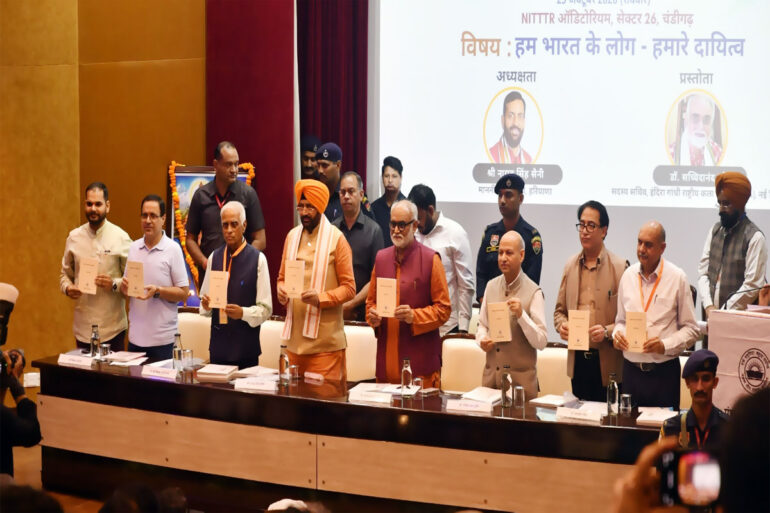
Panchnad Shodh Sansthan organised its 33rd Annual Lecture at NITTTR, Sector 26, Chandigarh, on the theme “We the People of India – Our Responsibilities.” More than 350 intellectuals from Jammu, Himachal Pradesh, Punjab, Haryana, Delhi and Chandigarh attended the event. Haryana Chief Minister Nayab Singh Saini was the Chief Guest, and Dr. Sachchidanand Joshi, Member Secretary of the Indira Gandhi National Centre for the Arts (IGNCA), New Delhi, delivered the keynote address.
Chief Minister Nayab Singh Saini emphasised that democracy becomes stronger when citizens fulfil their duties alongside exercising their rights. Appreciating the institute’s efforts to connect society with its cultural heritage, he called for respect for constitutional institutions, women’s dignity and the inclusion of all sections of society. He noted that disagreement is an essential part of democracy but should not undermine national interest.
Highlighting India’s diversity as a source of strength, the Chief Minister stressed fraternity and mutual respect among communities. He underlined the importance of water conservation, soil health and natural farming to protect resources for future generations. He also referred to Haryana Government initiatives concerning Agniveers and the improvement of the sex ratio. Observing that every citizen’s contribution advances national development, he announced a grant of ₹11 lakh to Panchnad Shodh Sansthan for research focused on Haryana.
In his keynote address, Dr. Joshi said society was grappling with the growing divide between knowledge and information. Although technology has opened new opportunities, it has also created serious challenges. He emphasised the intellectual community’s role in guiding society and encouraging awareness of civic duties.
Dr. Joshi observed that patriotism is deeply rooted in Indian society, reflected in the pride people feel when they hear the national anthem or see the Tricolour. He stressed that national progress depends not only on constitutional institutions and governance but also on citizens’ awareness, participation and commitment to the public good.
He highlighted the importance of shared responsibilities, common goals and shared identities in uniting India’s diverse communities. A common sense of belonging, he said, can bring people together to pursue national aspirations while respecting differences. Referring to contemporary social challenges, including population imbalance, he urged society to remain connected to its cultural roots. He also emphasised values such as culture, civilisation, character, contentment, consciousness and compassion. During the interactive session, he praised young Indians for pursuing their goals with dedication and encouraged society to channel their energy towards constructive change and Viksit Bharat 2047.
Earlier, institute president Prof. Brij Kishore Kuthiala presented Panchnad: Today and Tomorrow, outlining the organisation’s dialogue and research initiatives. He noted that its platforms had brought more than 20,000 people together to discuss social issues and highlighted plans for research into Punjab’s historical and contemporary economic conditions.
The programme also featured the release of the institute’s research journal, a monograph and several books, including The Genocide of Hindus in Bengal. NITTTR Director Dr. Bhola Ram Gurjar and distinguished participants from across the region were present.