






Shimla, November 7
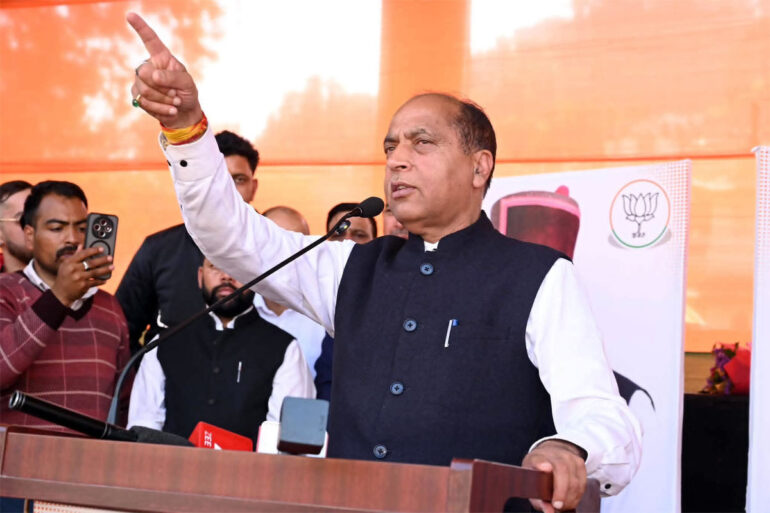
Former Chief Minister and Leader of Opposition Jairam Thakur, while addressing a press conference at his private residence in Shimla, welcomed the Supreme Court’s historic November 6 verdict concerning Himachal Pradesh’s electricity share in the Bhakra Beas Management Board (BBMB). He launched a sharp attack on Chief Minister Sukhvinder Singh Sukhu for attempting to claim political credit for a decision that represents nearly three decades of legal struggle, sustained efforts by successive state governments, judicial intervention, and the significant contribution of the Central Government.
Thakur said that the Chief Minister should refrain from portraying the judgment as his personal achievement. He emphasised that the verdict is a collective victory for the people of Himachal Pradesh and the culmination of a long struggle to secure the state’s legitimate rights. Tracing the history of the dispute, Jairam Thakur said that the issue of Himachal Pradesh’s rightful share arose following the reorganisation of Punjab in 1966. Former Chief Minister Shanta Kumar had strongly advocated the concept of royalty on water resources, arguing that Himachal Pradesh deserved compensation for its natural resources.
Thakur recalled that the matter was taken to the Supreme Court in 1996 during the tenure of former Chief Minister Virbhadra Singh. Subsequently, on September 27, 2011, during the BJP government led by Professor Prem Kumar Dhumal, the Supreme Court delivered a landmark judgment recognising Himachal Pradesh’s 7.19 percent electricity share in the BBMB projects. “The most significant legal milestone was achieved in 2011 when Professor Prem Kumar Dhumal was Chief Minister. The Sukhu government cannot erase this history merely because the final judgment has been delivered during its tenure,” Thakur said. He further explained that during his own tenure as Chief Minister, the Himachal Pradesh Cabinet, on January 4, 2018, approved further negotiations regarding the return of differential energy. The state government continued pursuing the matter before the Supreme Court and with the concerned states.
Thakur said that important developments took place during 2019 and 2020, including directions from the Supreme Court requiring the concerned parties to submit their positions. The intervention of the Attorney General of India, representing the Union Government, subsequently helped develop a practical cashless settlement mechanism. Under this arrangement, the outstanding dues would be settled through electricity supply rather than direct monetary payments.
According to the Supreme Court’s November 6 judgment, Himachal Pradesh will receive approximately 11,973 million units (MU) of electricity over the next 20 years, after adjustment of capital liabilities. Around 598 MU of electricity will be supplied annually during the lean generation season, primarily from October to March. Thakur said this arrangement would provide substantial relief to Himachal Pradesh, particularly during winter when hydropower generation declines and the state is compelled to purchase electricity from outside at higher rates. He expressed gratitude to Prime Minister Narendra Modi and the Central Government for their contribution towards resolving the longstanding dispute.
“The Supreme Court delivered this judgment on the merits of the case, and the Attorney General played a crucial role in facilitating the settlement. The Central Government deserves recognition for its constructive intervention. Chief Minister Sukhu should explain what extraordinary contribution his government made that justifies claiming exclusive credit,” Thakur remarked. The Leader of Opposition also criticised the Congress government for its handling of the power sector. He demanded that the state government ensure uninterrupted, affordable electricity supply to households, industries and rural areas, and restore the 125 units of free electricity introduced during the previous BJP government.