




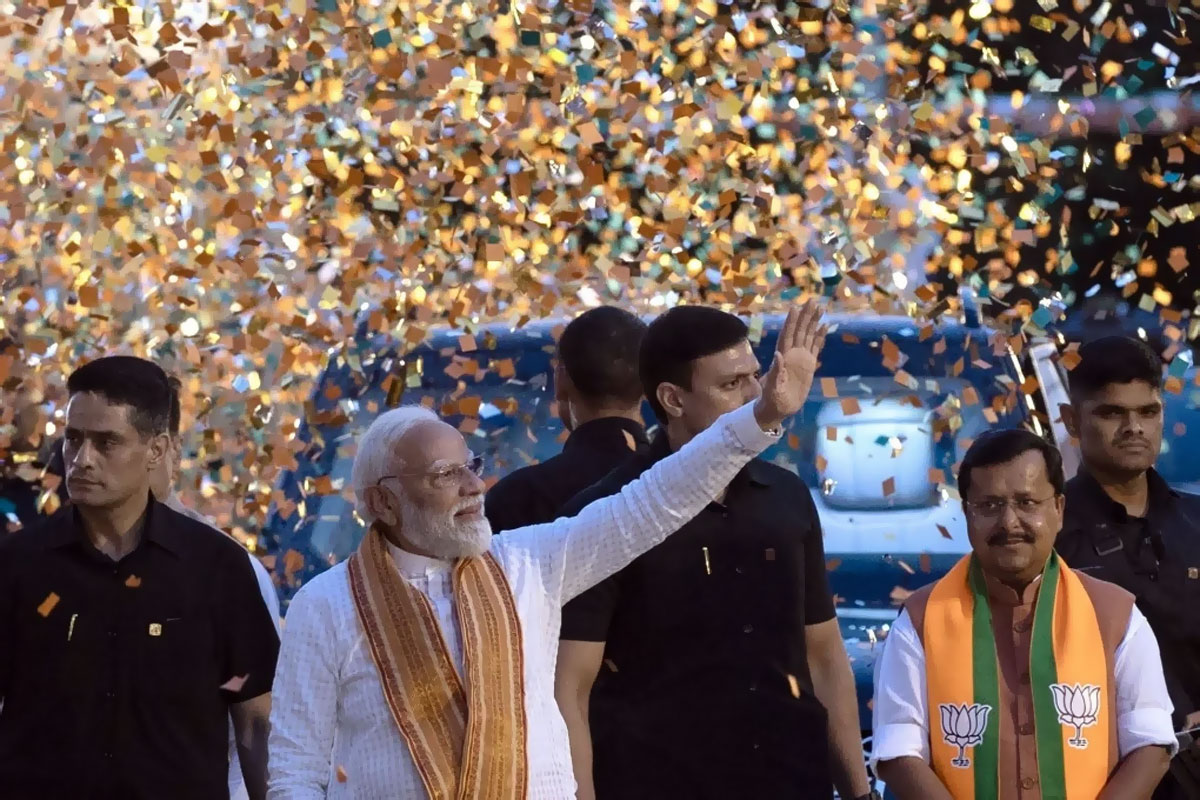
What began as “Mission Bengal” in late 2025 has culminated in one of the most dramatic political transformations in modern Indian history. The Bharatiya Janata Party (BJP), fresh off a resounding landslide in Bihar, turned its gaze eastward with a blueprint crafted by Prime Minister Narendra Modi and Union Home Minister Amit Shah. At the time, Bengal was considered a fortress—an impenetrable bastion of Mamata Banerjee’s Trinamool Congress (TMC). Yet, through relentless organization, disciplined strategy and a narrative built on law and order, women’s safety and cultural nationalism, the BJP stormed to an absolute mandate in the 2026 Assembly elections, ending fifteen years of uninterrupted Trinamool rule.
The campaign’s opening act was symbolic. Modi launched the Bengal drive with a mega rally in Arambag, declaring that just as the Ganga flows from Bihar into Bengal, so too would the BJP’s electoral wave surge eastward. Unlike Bihar, where the saffron surge swept effortlessly, Bengal demanded grit and ground work. Party insiders admitted it was no cakewalk. The BJP’s strategy centered on uniting Hindu voters who, despite intimidation and exploitation, had remained restrained and less vocal. The campaign spotlight was firmly on alleged law and order breakdowns, branding the situation as “Jungle Raj under TMC.” Women’s safety emerged as a defining issue, with the party highlighting daily atrocities and the horrific gang rape of a medical student in Durgapur. The message was clear: Bengal needed change.
Organizational muscle was the BJP’s immediate priority. Out of Bengal’s 91,000 polling booths, committees were established in nearly 70,000 by December, signaling a ground-level push designed to convert momentum into victory. Union Minister Bhupendra Yadav was entrusted as poll in charge, joined by former Tripura Chief Minister Biplab Kumar Deb as co-incharge. The deployment of seasoned leaders underscored the seriousness of the mission. At a high-level strategy meeting, Amit Shah delivered a decisive message: “We must go where our organisational strength is weak. Reaching people directly is the key. The foundation is ready and now we must build on it.” The campaign narrative was sharpened by blistering attacks from BJP leaders across states. Haryana Chief Minister Nayab Singh Saini accused Mamata Banerjee of minority appeasement and worsening conditions for women, while Modi urged Bengal MPs to intensify grassroots engagement and keep the Special Intensive Revision (SIR) of electoral rolls transparent. The SIR itself became a flashpoint, with opposition parties protesting the removal of nearly 8.9 million names.
By the time polling was conducted in April, Bengal had become a high-voltage battleground. The BJP’s disciplined cadre, sharpened narrative and relentless focus contrasted with a Trinamool campaign weighed down by incumbency fatigue. The stakes were monumental: 294 seats, a simple majority of 148 required to claim power. The Bengal campaign had been a fierce collision of ideologies, promises of welfare and calls for change. The victory was not just electoral arithmetic—it was ideological acceptance. Bengal, once resistant to the BJP’s cultural nationalism, had embraced it.
This triumph is the culmination of a long journey. From zero seats in 2011 to three in 2016 to 77 in 2021, the BJP’s ascent was steady. It did not merely ride anger; it built a narrative of cultural reclamation and national integration.
For Bengal, the change is seismic. The state has long been a theater of ideological battles—from the Left fortress to Mamata’s populist wave. Nationally, the implications are profound. Bengal was often cited as the last frontier, incompatible with the BJP’s vision. That myth now lies shattered. The victory demonstrates that the party’s model is truly pan Indian, adaptable, and resilient. It signals to opposition parties that the BJP’s march is not confined to the Hindi heartland but extends to regions with strong regional traditions.
In essence, “Mission Bengal” was not just a campaign slogan—it was a blueprint for conquest. From booth-level committees to blistering attacks, from Modi’s symbolic rally to Shah’s organizational mantra, the BJP executed its plan with discipline and determination. The result is historic: Bengal, once the fortress of resistance, now stands as the stage for the BJP’s ascent. It is a paradigm shift that will echo across India’s political landscape for years to come.
(The author is a budding journalist. Views expressed are personal.)