



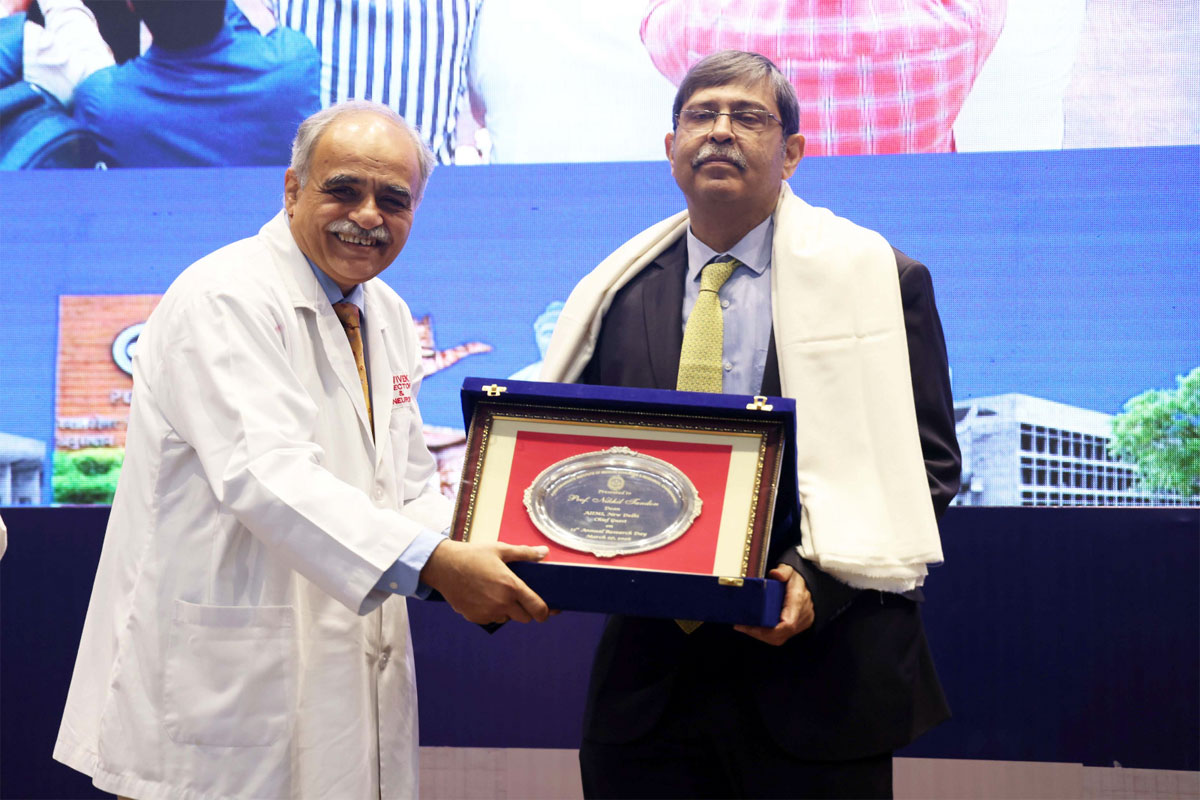
Chandigarh, March 7
With 329 research papers published during last one year on display, 35 researchers winning awards in the surgical, medical, and basic sciences fields for ‘Research publications’ and 59 researchers being awarded in the ‘Innovations’ category for their exemplary and credible research work, PGIMER’s 12th Annual Research Day, the big ticket medical research showcase, concluded on an upbeat note here at PGIMER today.
Addressing the gathering as Chief Guest, Prof. Nikhil Tandon, Dean, AIIMS New Delhi , praised the depth, diversity and quality of research being carried out at PGIMER as he stated, “After going through the scope and breadth of research being carried out at PGIMER, I can say with confidence that the quality of work being done here is truly exceptional. The scientific community in this institution clearly understands what needs to be done to advance medical knowledge and improve patient care.”
Prof. Tandon delivered a special address titled “Wearing Two Hats: Doctor’s Dilemma,” where he reflected on the complex responsibilities faced by clinician-scientists.“Most medical professionals in India wear two hats—one of providing patient care and the other of pursuing research. Balancing these responsibilities is not easy, but it is essential if we want to improve healthcare and generate meaningful scientific knowledge.”
“Research is never a short journey. It demands patience—sometimes over years or even decades—before its real impact becomes visible. The work we do today may not transform healthcare immediately, but with commitment and rigour it eventually contributes to knowledge that benefits society, ” as Prof. Tandon spoke about the nature of scientific discovery, emphasizing that impactful research requires patience and sustained effort.
The Chief Guest also highlighted the importance of mentorship and collaborative academic environments as he stated, “Great research rarely happens in isolation. Institutions that nurture mentorship, collaboration and a critical mass of researchers create an environment where ideas flourish and innovation becomes possible.”
Underscoring the true purpose of scientific inquiry, Prof. Tandon concluded, “The most sustainable motivation for research is genuine curiosity and the desire to improve patient care. Publications and recognition may follow, but they should never be the sole driving force. Research must remain connected to real health challenges so that the knowledge we generate ultimately improves outcomes for our patients and communities.”
Earlier, Prof. Vivek Lal, Director, PGIMER, welcoming the Chief Guest, highlighted the institute’s strong culture of scientific inquiry and research excellence as he stated, “Despite the enormous clinical workload handled by the institute, PGIMER stands on a very high pedestal when it comes to patient care. With an annual patient footfall of nearly 40 lakh, our clinicians remain deeply engaged in delivering healthcare services. Yet, despite this tremendous pressure, our faculty, residents and healthcare professionals continue to pursue high-quality research with remarkable dedication.”
Awards were presented across several categories including medical specialties, surgical specialties, pre- and para-clinical sciences, senior residents, PhD scholars and systematic reviews, recognising outstanding contributions from faculty members and young investigators.
A key highlight of the event was the felicitation of three distinguished PGIMER faculty members who have been honoured with the prestigious Shanti Swarup Bhatnagar Awards for their outstanding scientific contributions. These included Prof. Ritesh Aggarwal from the Department of Pulmonary Medicine, recipient of the Shanti Swarup Bhatnagar Prize (2020) for his pioneering research on Allergic Bronchopulmonary Aspergillosis (ABPA); Prof. Jitendra Kumar Sahu from the Department of Paediatrics, who received the Shanti Swarup Bhatnagar Vigyan Yuva Puraskar (2024) for his work in paediatric epilepsy and Prof. Suresh Kumar, also from the Department of Paediatrics, who received the 2025 award for his research demonstrating the life-saving potential of probiotics in critically ill children admitted to intensive care units.