




Chandigarh, May 16
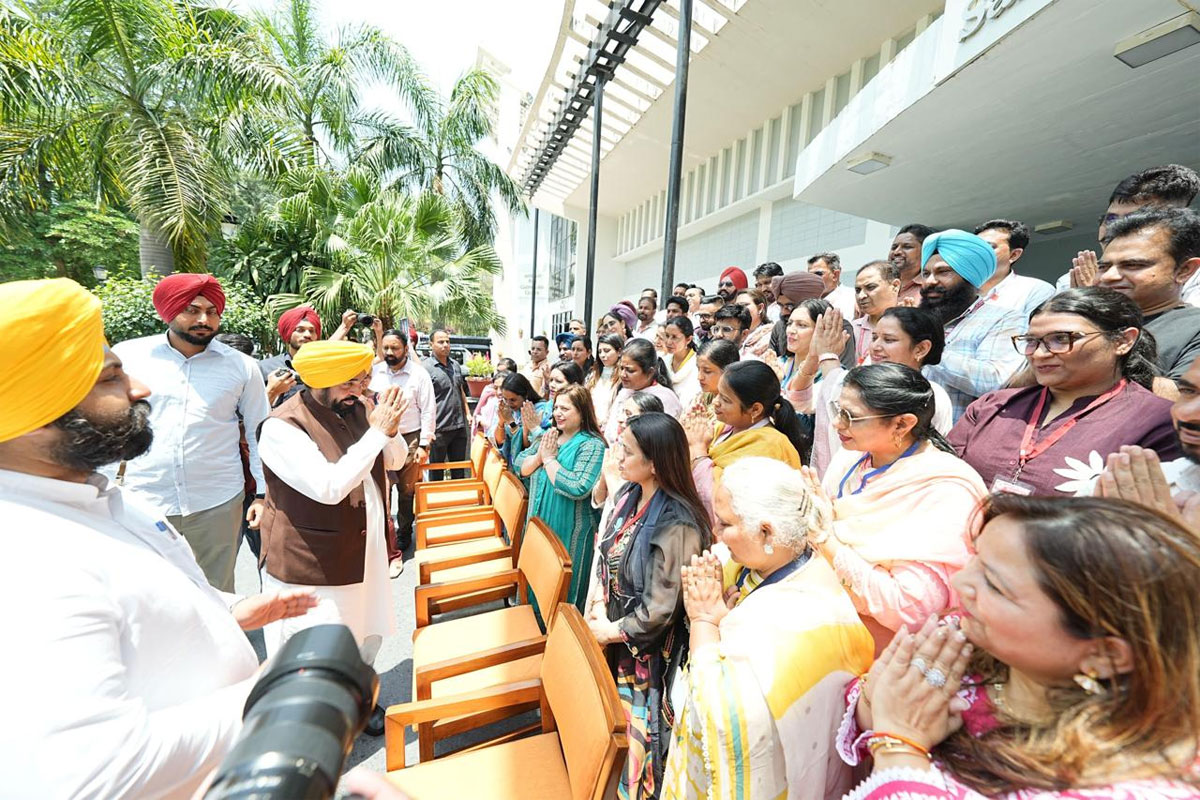
Chief Minister Bhagwant Mann on Saturday flagged off the largest-ever batch of 72 government school teachers for advanced training in Finland, asserting that the Punjab Government’s investment in teacher training, modern classrooms and academic reforms has transformed Punjab into the country’s leading state in education.
Drawing a sharp contrast with the decades-long neglect of public education by previous governments, Mann said Punjab’s government schools are now outperforming private schools in board examination results, while lakhs of parents are voluntarily participating in Parent-Teacher Meetings started for the first time by the present government. He maintained that exposure to world-class education systems is helping create revolutionary changes inside classrooms and strengthening the Punjab Government’s mission to make government schools the first choice of every parent.
Addressing the teachers before their departure, Mann said, “A total of 72 government school teachers have been selected for advanced pedagogical training at the globally acclaimed University of Turku in Finland. These teachers will undergo intensive exposure to modern teaching methodologies, innovative classroom practices, student-centric learning models and globally benchmarked education systems till May 29.”
The Chief Minister stated, “This initiative marks another major milestone in Punjab’s education reform programme, which has emerged as one of the most aggressively pursued governance transformations in the country.”
Describing teachers as the “true nation builders” entrusted with shaping Punjab’s future generations, CM Bhagwant Singh Mann said, “The Punjab Government is not merely investing in infrastructure but fundamentally rebuilding the educational ecosystem from the ground up. Punjab’s education reforms are no longer confined to policy announcements but are now producing measurable and nationally recognised outcomes.”
Citing the latest educational indicators released by NITI Aayog, Mann stated, “Punjab has outperformed several traditionally strong educational states, including Kerala, Maharashtra and Haryana, across multiple parameters related to school education.” He added, “Punjab has registered exceptional performance in Mathematics, Science and Language proficiency while simultaneously emerging as a frontrunner in smart school infrastructure, digital learning facilities and classroom management standards. The results clearly demonstrate that government schools in Punjab are undergoing a historic transformation after decades of neglect.”
Highlighting the significance of the Finland training programme, Mann asserted, “This initiative is part of a broader strategy to equip Punjab’s teachers with international exposure and future-ready educational practices. It is not merely a ceremonial foreign visit but a structured learning experience aimed at bringing practical innovation directly into Punjab’s classrooms.” He further stated, “The teachers will closely study Finland’s globally celebrated education system, which is known for its emphasis on conceptual learning, critical thinking, emotional well-being of students and minimal rote memorisation. The training will also focus on collaborative teaching techniques, classroom engagement models, assessment reforms and integration of technology in education.”
Referring to the impact of earlier international training batches, Mann asserted, “The positive outcomes are already visible across government schools in Punjab. Trained teachers have introduced more interactive learning environments, improved classroom discipline and adopted student-friendly approaches that have significantly enhanced academic performance.”
Highlighting the scale of infrastructure improvement undertaken by the Punjab Government, Mann said, “Computers are now available in nearly 99 per cent of government schools, while electricity connectivity has reached almost 99.9 per cent institutions across Punjab. These developments have laid the foundation for a technologically empowered and inclusive education system.”