




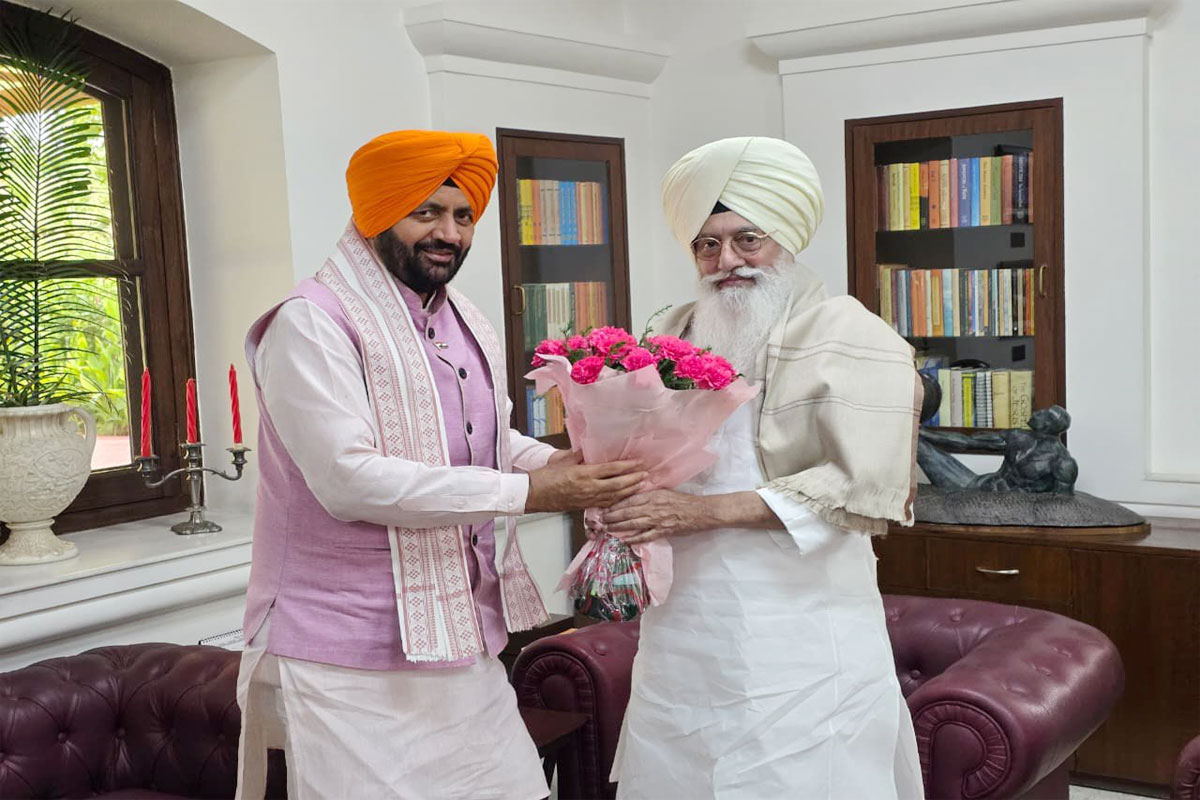
Chandigarh, May 31
The Bharatiya Janata Party’s efforts to deepen its social and political engagement in Punjab became more evident on Saturday when Haryana Chief Minister Nayab Singh Saini called on Dera Radha Soami Satsang Beas chief Baba Gurinder Singh Dhillon, barely a day after newly appointed Punjab BJP president Kewal Singh Dhillon paid a similar visit.
While both meetings were officially described as courtesy calls, their political significance is difficult to ignore. The back-to-back visits come at a time when the BJP is recalibrating its strategy in Punjab, where it has been attempting to build an independent political base after parting ways with its long-time ally, the Shiromani Akali Dal.
Significantly, Dhillon’s move was widely viewed within political circles as a signal that the party intends to broaden its outreach beyond its traditional urban support base and connect with wider social constituencies across the state.
The BJP leadership appears conscious that Punjab’s electoral landscape is shaped not only by conventional political mobilisation but also by influential social, religious and community institutions that command goodwill among large sections of society. Engagement with such institutions has long been part of the political playbook of almost every major party in the state.
Dera Radha Soami Satsang Beas, despite maintaining a strictly non-political stance and refraining from issuing electoral directions, remains one of the most influential socio-spiritual organisations in North India. Leaders cutting across party lines — from the Congress, BJP, AAP and Shiromani Akali Dal — have routinely paid visits to the dera over the years.
The timing of the visits is noteworthy. With the 2027 Punjab Assembly elections gradually coming into focus, the BJP is seeking to strengthen its organisational presence, expand its rural reach and establish connections with communities where its influence has traditionally been limited.
The appointment of Dhillon is itself being viewed as part of the BJP’s broader effort to expand its appeal among Punjab’s Sikh electorate. His outreach at Beas, followed immediately by Saini’s visit, reinforces the message that the BJP is investing considerable political capital in building wider acceptability across Punjab’s social landscape.
Whether this strategy ultimately translates into electoral gains remains to be seen, but the party’s intent to widen its footprint in Punjab is becoming increasingly visible.