




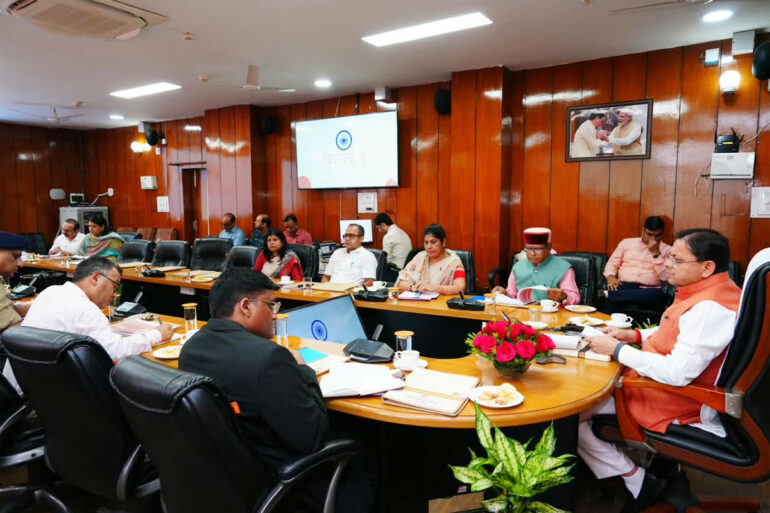
Dehradun, September 22
A meeting of the State-Level Vigilance and Monitoring Committee, constituted for effective implementation of the Scheduled Castes and Scheduled Tribes (Prevention of Atrocities) Act, 1989, was held on Tuesday at the Secretariat under the chairmanship of Chief Minister Pushkar Singh Dhami. The Chief Minister said that the committee’s meeting should not remain limited to formal review. It must be ensured that every person affected by atrocities receives timely justice, security, dignity, and their rightful entitlements. For this, regular review of cases should be conducted, and the entire system made more sensitive, accountable, and effective.
The Chief Minister directed that cases registered under the Act since 2024, where investigations are still pending, must be reviewed to identify reasons for delay and ensure time-bound disposal on priority. In long-pending and serious cases, police, administration, and prosecution departments should act in coordination. He also instructed regular review of cases pending in special courts. For speedy disposal of old cases, better coordination between police and prosecution is essential, and availability of special public prosecutors should be ensured wherever required.
The Chief Minister emphasized that victims must not face delays in receiving admissible relief amounts. Cases where relief has been delayed should be separately reviewed. He said assistance to affected families should not remain confined to financial aid alone; they should also be linked to medical, education, security, rehabilitation, and other eligible government schemes. In serious and sensitive cases, the safety of victims and their families must be the highest priority. It should also be ensured that children’s education is not disrupted due to such incidents, and eligible children should be connected to scholarships and other educational assistance schemes. Counseling, medical support, security, and social and economic rehabilitation measures for affected families were also discussed. The Chief Minister directed that senior-level accountability be ensured in every district for regular monitoring of cases under the Act.
He instructed police officers and staff to be given regular training on the provisions of the Act, investigation of sensitive cases, and appropriate behavior with victims. The Social Welfare, Police, and Prosecution departments should jointly organize refresher training from time to time. The Chief Minister also directed the development of a digital monitoring system for effective oversight at the government level regarding investigations, court proceedings, relief payments, and other assistance. Districts showing inadequate progress in disposal, investigation, or relief distribution should be separately reviewed, while effective practices from well-performing districts should be shared with others.
The Chief Minister instructed that extensive awareness campaigns be conducted in rural and remote areas about the provisions of the Act, legal rights, and available assistance for victims. He stressed better coordination among police, social welfare, education, health, revenue, and other related departments. If any district or department requires additional manpower, training, or budget, proposals should be promptly submitted to the government.
He said that decisions taken in the meeting should not remain confined to minutes of proceedings. Responsibility and timelines must be fixed for each decision, with regular reviews. It must be ensured that victims do not have to wander for justice and assistance, and that the administration stands with them with full sensitivity.
The meeting was informed that 189 cases were registered under the Act in 2024, 157 in 2025, and 116 cases up to September 15, 2026, of which 25 are under investigation. It was also reported that in 2024–25, 205 victims received ₹228.71 lakh in assistance; in 2025–26, 127 victims received ₹143.16 lakh; and in 2026–27 (up to September 18), 104 victims received ₹99.528 lakh. Meetings have been regularly organized under the chairmanship of the Chief Secretary and District Magistrates at the district level.