




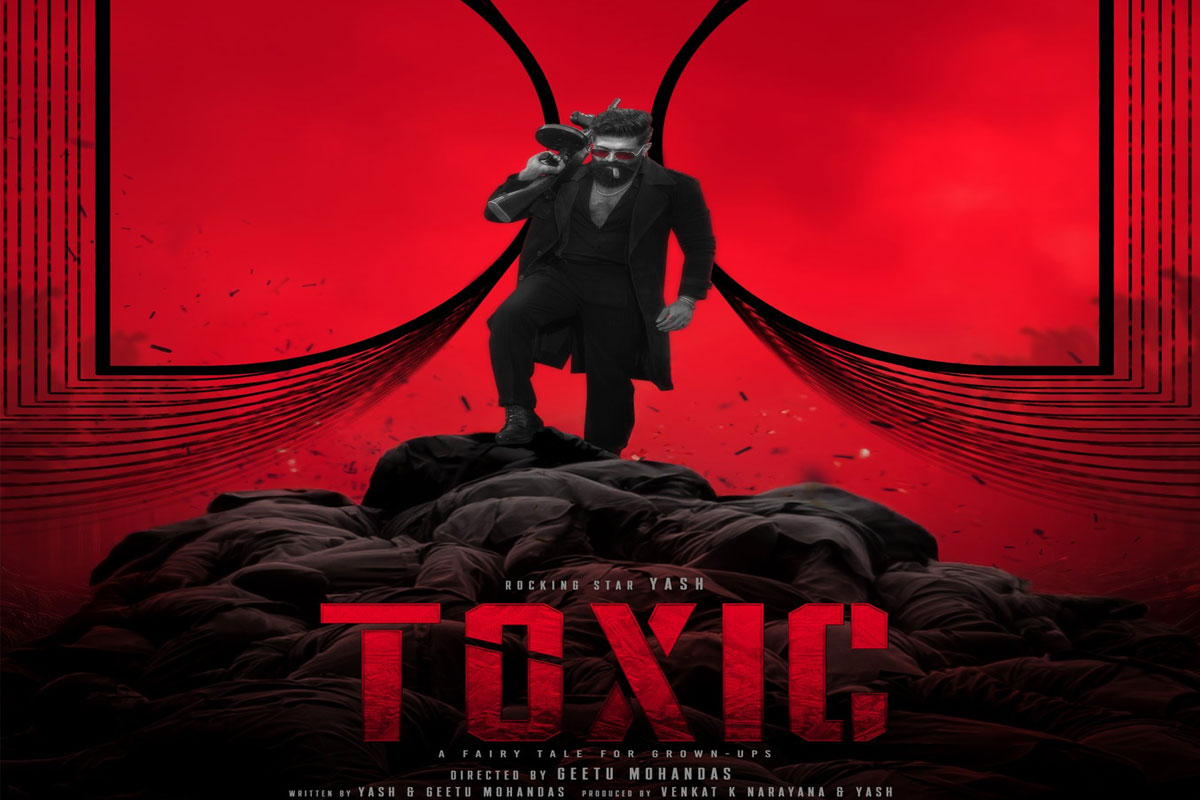
There is no denying that Toxic: A Fairy Tale for Grown-Ups arrives with enormous ambition. After KGF: Chapter 2, Yash returns to the big screen in a film that attempts to combine gangster drama, period spectacle, family conflict, stylised violence and dark fairy-tale imagery. Directed by Geetu Mohandas and featuring an impressive ensemble led by Yash, Nayanthara and Kiara Advani, Toxic is clearly designed as a larger-than-life cinematic experience. The problem is that the film often appears far more interested in creating an imposing world than in telling a compelling story within it.
Set against a stylised Goa beginning in 1947 and spanning roughly two decades, the film revolves around Raya, played by Yash, and his sister Ganga, played by Nayanthara. Their troubled relationship with their family becomes intertwined with the underworld and the opium trade. Raya’s rise through this violent world is presented as a mixture of ambition, rebellion, betrayal and survival. The narrative also brings several women into his orbit, including Kiara Advani’s Nadia, while Yash’s dual-role performance adds another layer to the sprawling story.
Yash is unquestionably the film’s biggest asset. He has the physical presence, swagger and command of the screen required for a character who is supposed to dominate every room he enters. His entry scenes and several action passages are built specifically around his star power, and he delivers them with the confidence audiences have come to expect from him. Yet there is also a problem here: at times, Raya feels less like a completely new character and more like another variation of the larger-than-life persona that made Yash a pan-Indian star in the KGF films. The swagger, slow-motion hero shots and larger-than-life presentation occasionally remind one too strongly of Rocky.
Nayanthara brings authority and emotional credibility to Ganga, but the writing does not consistently give her enough material to match her abilities. Kiara Advani looks striking and handles her role effectively, while the supporting female cast, including Tara Sutaria, Rukmini Vasanth and Huma Qureshi, adds considerable star value. Unfortunately, many of these characters feel underdeveloped in a screenplay already crowded with people, subplots and shifting motivations.
Where Toxic truly impresses is its technical ambition. The production design, cinematography, costumes and action choreography create a distinctive visual universe. Geetu Mohandas clearly wants the film to look unlike a conventional gangster entertainer, and there are stretches where that vision works brilliantly. The action sequences possess scale and physicality, while Ravi Basrur’s music gives several major moments the thunderous energy demanded by a Yash vehicle.
But spectacle alone cannot carry a film lasting more than three hours. The screenplay is the weakest link. The story repeatedly moves between characters, time periods and conflicts without giving enough breathing space to establish their emotional stakes. Instead of building naturally towards its major confrontations, the narrative sometimes seems to jump from one grand sequence to another. The result is a film that looks expensive but does not always feel emotionally invested in its own characters.
This is also where comparisons with KGF become unavoidable. Both films place Yash at the centre of an underworld saga and surround him with a mythology of power, violence and destiny. Toxic attempts to be darker, stranger and more stylistically ambitious, but its storytelling occasionally gets buried beneath that ambition.
Toxic is therefore a curious cinematic contradiction. It has the scale of an event film, the visual imagination of an ambitious filmmaker and a superstar capable of commanding the screen, yet its narrative lacks the discipline necessary to turn those strengths into a consistently satisfying experience. For Yash fans, the action, attitude and sheer visual spectacle may provide enough entertainment. For viewers looking for a tightly written gangster drama with emotional depth, the film may prove frustrating.
Ultimately, Toxic is not short on ambition; it is short on restraint. It wants to be a fairy tale, gangster epic, family drama and pan-Indian spectacle at the same time. Some of those ambitions succeed spectacularly. Others get lost in the noise. What remains is an undeniably stylish but uneven film that looks far more confident than the story it is trying to tell.