




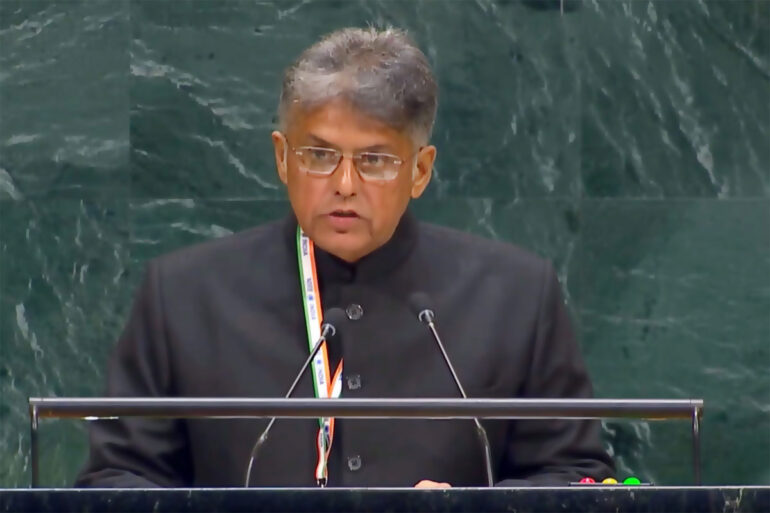
Chandigarh, October 22
Former Union Minister for Information & Broadcasting and Chandigarh MP Manish Tewari, while addressing the United Nations General Assembly (UNGA) presented India’s voice on global peace, security and diplomacy. In his address, Tewari said, “We thank the President of the International Residual Mechanism for Criminal Tribunals, Judge Graciela Gatti Santana, for a report contained in document A/81/287 and acknowledge her efforts towards the effective implementation of the mechanism’s mandate.”
Tewari further said, “We recognize the mechanism’s contribution to the fight against impunity and reiterate the importance of fulfilling its mandate in accordance with the principles of justice, impartiality, fairness and due process. Upholding the interests of justice and protecting the rights of victims remains essential.”
Tewari added that during the reporting period, the mechanism has made considerable progress in discharging its judicial and residual functions. “As the institution moves towards completing its mandate, we emphasize the need for an efficient, orderly and time-bound transition without compromising judicial independence or the effective discharge of its remaining responsibilities,” he added.
Tewari asserted that India underscores the importance of the mechanism continuing residual functions, including the protection of victims and witnesses, assistance to national jurisdictions and the preservation and management of the tribunal’s archives. “These functions remain essential to safeguarding the legacy of the ad hoc tribunals and ensuring continued accountability,” he said.
Tewari also said, “We also stress the importance of cooperation between the mechanism and the United Nations Secretariat and the concerned Member States in addressing outstanding legal, administrative and logistical challenges. Any proposed transfer of functions to the United Nations Secretariat should be guided by legal clarity, accountability, institutional continuity and due consideration given to the associated financial and administrative implications.”
Tewari told the gathering that India emphasizes the preservation and accessibility of the mechanism’s archives are vital for historical documentation, research and the interests of justice. “We also recognize the importance of continued assistance to national jurisdictions in accordance with the mechanism’s mandate to strengthen domestic capacity and facilitate accountability for serious international crimes,” he told the General Assembly.
“We remained concerned about the situation of the acquitted and released persons relocated to Niger. In this regard, we note the decision given by a single judge on 21st of November 2025, according to which the mechanism would no longer have a legal or judicial obligation to provide further financial assistance to these individuals after the 31st of December 2026,” Tewari said.
Tewari added, “We encourage all concerned parties to pursue a cooperative and durable solution that safeguard the dignity and the rights of the individual concerned.” In conclusion, he said, “We call upon all the member states to contribute constructively towards the timely and orderly completion of the mechanism’s mandate in accordance with the principles of justice and the rule of law.”