




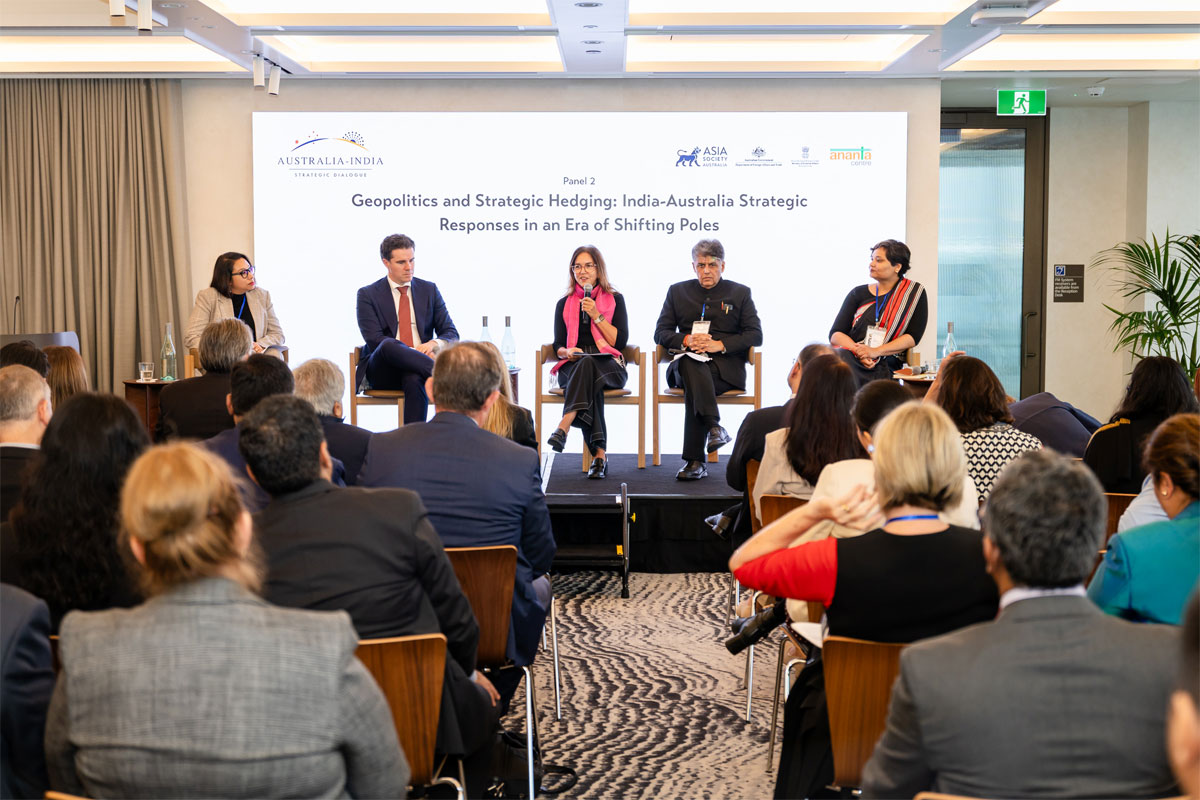
Former Union Information & Broadcasting Minister and Chandigarh MP Manish Tewari attended the two-day inaugural Australia–India Track 1.5 Strategic Dialogue that got underway in Sydney today. The Dialogue brought together leaders across government, industry and academia to explore trade, investment, economic resilience and the future of the Australia–India strategic partnership.
Supported by the Australian Department of Foreign Affairs and Trade (DFAT) through the Strategic and Technology Policy Initiative (SATPI) and by India’s Ministry of External Affairs (MEA), the Australia–India Track 1.5 Strategic Dialogue serves as a high-level forum to advance shared priorities and deepen the bilateral strategic partnership. The Dialogue is convened in collaboration with the Ananta Aspen Centre (India).
Tewari, who is also the President of India–Australia Parliamentary Friendship Group, spoke in detail during the session on ‘Geopolitics and Strategic Hedging: India-Australia Strategic Responses in an era of shifting poles’. Tewari noted that the inaugural dialogue centred on bolstering Australia–India economic and trade ties, with emphasis on advancing the implementation of ‘A New Roadmap for Australia’s Economic Engagement with India’ through practical pathways.
Tewari’s participation underscored India’s parliamentary and policy perspective, stressing the need to balance global volatility with regional partnerships. His interventions highlighted the convergence between India and Australia in countering China’s assertiveness, strengthening Indo-Pacific resilience and advancing cooperation in trusted technologies and clean energy. The dialogue also reinforced existing frameworks such as the Comprehensive Strategic Partnership, the Mutual Logistics Support Agreement and maritime security cooperation.
First session on day one of the Dialogue witnessed discussions on India-Australia relationship, while in the second session, deliberations were held on the geopolitics and strategic hedging that examined how US tariff regimes, China’s counter‑measures and instability in the Middle East are reshaping supply chains, market access and economic security. The session focused on how India and Australia can coordinate policy, investment and diplomacy to mitigate risk and turn disruption into partnership‑driven cooperation. The third morning panel turned to trade and investment, exploring how the Economic Cooperation and Trade Agreement (ECTA) and ongoing CECA negotiations can be translated into commercially viable projects, stronger two‑way flows and regulatory alignment, with emphasis on clean energy, digital trade, critical minerals and advanced manufacturing.
In the afternoon, closed‑door sessions drilled into specific areas of bilateral cooperation. The first focused on critical minerals, highlighting Indian firms’ growing interest in equity stakes, joint ventures and technology collaboration in Australian processing and refining for batteries and clean energy. The second session addressed energy security, looking at practical pathways to strengthen resilience in crude and LPG supply chains through long‑term arrangements, storage and logistics coordination. The third session shifted to people, skills and partnerships, examining how talent flows, education linkages, diaspora entrepreneurship and joint R&D can be harnessed to power the next phase of economic cooperation. The day concluded with a formal dinner and networking reception, underscoring the blend of strategic dialogue and relationship‑building that defines the Track 1.5 format.
Beyond the formal sessions, Tewari engaged with diaspora outreach events organized by the Indian Overseas Congress in Sydney, strengthening cultural and political ties. The dialogue marked a significant step in operationalizing India–Australia strategic cooperation, moving beyond policy alignment to practical collaboration in defence, technology and economic engagement.